Reviews
Part of Small Business Social Media for the Careful Reader: The 2027 View
The Small Business Social Media Questions Worth Asking Before Anything Else
Small business social media questions cover platform choice, posting cadence, content, metrics, moderation, scheduling, partnerships, boosting, and ownership.
What to take away
- A business does not need every platform or a generic posting frequency; channel fit and operating capacity decide the plan.
- Native metrics help diagnose content, but customer actions and business outcomes determine whether the program is useful.
- The business should retain recovery and ownership while giving each employee or supplier only the access needed.
Small business social media questions usually concern time, channels, content, results, and risk. These concise answers support planning, but platform rules and legal duties change. Verify current requirements for the business, market, and industry.
Does every business need every platform?
YouTube's current channel-permissions guide describes five permission levels for giving other people access without sharing a Google Account password. The available duties differ by role, and some actions remain unavailable to delegates.
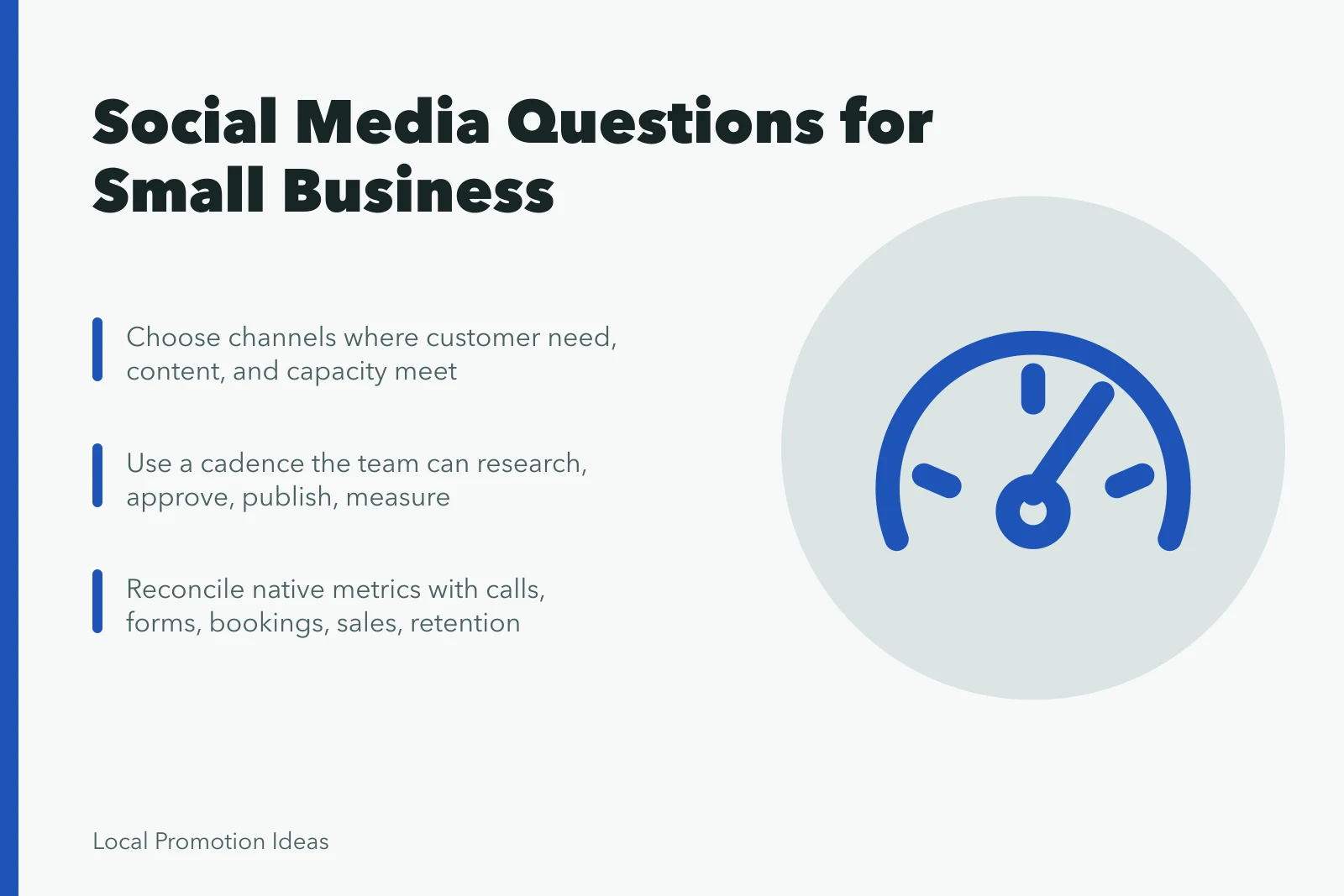
No. Choose channels where a defined customer need, suitable content, and operational capacity meet. One well-run primary channel plus an owned destination is stronger than several abandoned profiles. A decision rule: if nobody can answer comments within one business day or publish twice a month, do not open the channel.
Fit still varies. Visual products tend to suit Instagram or Pinterest, local services often suit Facebook, business-to-business work often suits LinkedIn, and demonstrations that repay filming suit YouTube.
How often should a small business post?
Start with two or three posts a week on the primary channel, and add more only when quality holds. That is a typical starting point, not a rule. Test it by running one cadence for four to six weeks, then comparing the same measures across two like periods.
Cadence the team can sustain
- Research
- Approve
- Publish
- Support
- Measure consistently
- Compare like periods
What should the business publish?
Start with customer questions, demonstrations, choices, processes, proof, limitations, service updates, local context, and staff expertise. Each post should help a specific audience understand or do something.
What to publish
- Customer questions
- Demonstrations
- Choices
- Processes
- Proof
- Limitations
- Service updates
- Local context
Which metrics matter?
Use native reach and engagement measures diagnostically, then reconcile them with qualified visits, calls, forms, bookings, sales, returns, and retention. A post with 10,000 impressions and one booking is weaker than one with 800 impressions and nine bookings. Metric definitions differ across platforms.
Should comments ever be deleted?
Apply a published moderation standard consistently. Preserve criticism unless it violates a legitimate rule. Remove or restrict threats, private data, impersonation, scams, illegal material, or targeted abuse under documented escalation.
Are scheduling tools necessary?
Not always. Native tools may be enough for one or two channels. Add software only when approvals, reporting, workload, or collaboration justify its access, cost, and failure risk. Common options include Buffer, Hootsuite, Later, and Metricool.
Entry paid plans typically run about $6 to $30 a month for a few channels; team plans with approvals commonly reach $99 or more, so check current pricing. Tool choices belong in the wider small business marketing strategy, where channel roles and economics are settled first.
Can employees share customer content?
Only with appropriate permission, rights, privacy protection, and policy review. Consent for service does not automatically authorize public promotion, and sensitive sectors need stricter controls.
When must a partnership be disclosed?
The FTC advises disclosure of material brand relationships, including money, employment, family ties, discounts, gifts, and other value. Put a clear disclosure with the endorsement; check other jurisdictions too.
Should a popular post be boosted?
Only after confirming audience, offer, destination, tracking, budget, exclusions, claim review, and stop conditions. Organic response does not establish advertising profitability.
Who should own the accounts?
LinkedIn's Page administrator overview separates Page and paid-media roles and lists super admin, content admin, and analyst access. Existing administrators grant roles, so a business should name accountable owners, retain recovery records, and avoid leaving a supplier as the only person able to administer the Page.
Keep control of billing, data, and offboarding, and give named staff or agencies the minimum roles needed.
Social media question record
| Question | Evidence | Owner decision |
|---|---|---|
| Which channel? | Audience need, format, workload, risk | Operate or decline |
| What cadence? | Capacity, quality, response, results | Sustain or reduce |
| Who controls it? | Roles, recovery, billing, offboarding | Retain business control |
Evaluation and privacy references
The GAO evaluation design guide connects evaluation questions with evidence needs and design choices. Apply that discipline to small business social media questions.
The W3C Privacy Principles statement gives web-system designers shared privacy concepts and warns against shifting privacy work to individuals. Apply it, then check the governing law and settings.
Common questions
Is follower growth a business goal?
It can be a diagnostic measure, but it does not show customer fit, qualified demand, sales, service quality, or profit on its own.
Should criticism be deleted?
Preserve ordinary criticism and apply a documented rule consistently. Restrict threats, scams, exposed private data, impersonation, or targeted abuse under an escalation process.
Can an agency manage the accounts?
Yes, but the business should retain ownership, recovery, billing visibility, data, archives, approval authority, and an executable offboarding plan.