Reviews
Part of Getting Small Business Marketing Strategy Right the First Time
Best Small Business Marketing Tools Picks, Ranked by What Matters
Best small business marketing tools ranked by what matters: research, local search, email, retention, and advertising, with what each costs.
What to take away
- The list ranks small business marketing tools by the decision each one improves per hour of owner time.
- Census Business Builder and Google Trends are free and answer market questions. The paid tools answer visibility, diagnosis and retention questions.
- Local search splits in two. Whitespark keeps citations consistent, and Sterling Sky diagnoses ranking changes.
- Email splits three ways. InboxArmy builds campaigns, Flowium runs Klaviyo retention, and Mailchimp starts a first list.
- Every paid tool publishes its own pricing, so check the vendor page before you budget.
- No tool here guarantees ranking, leads or return. Each one shortens the distance between a question and an answer.
How this list is ranked
Ranking is by decision value per hour of owner time. A tool scores high when it answers a question you already have, in one sitting, without a consultant.
1. Census Business Builder
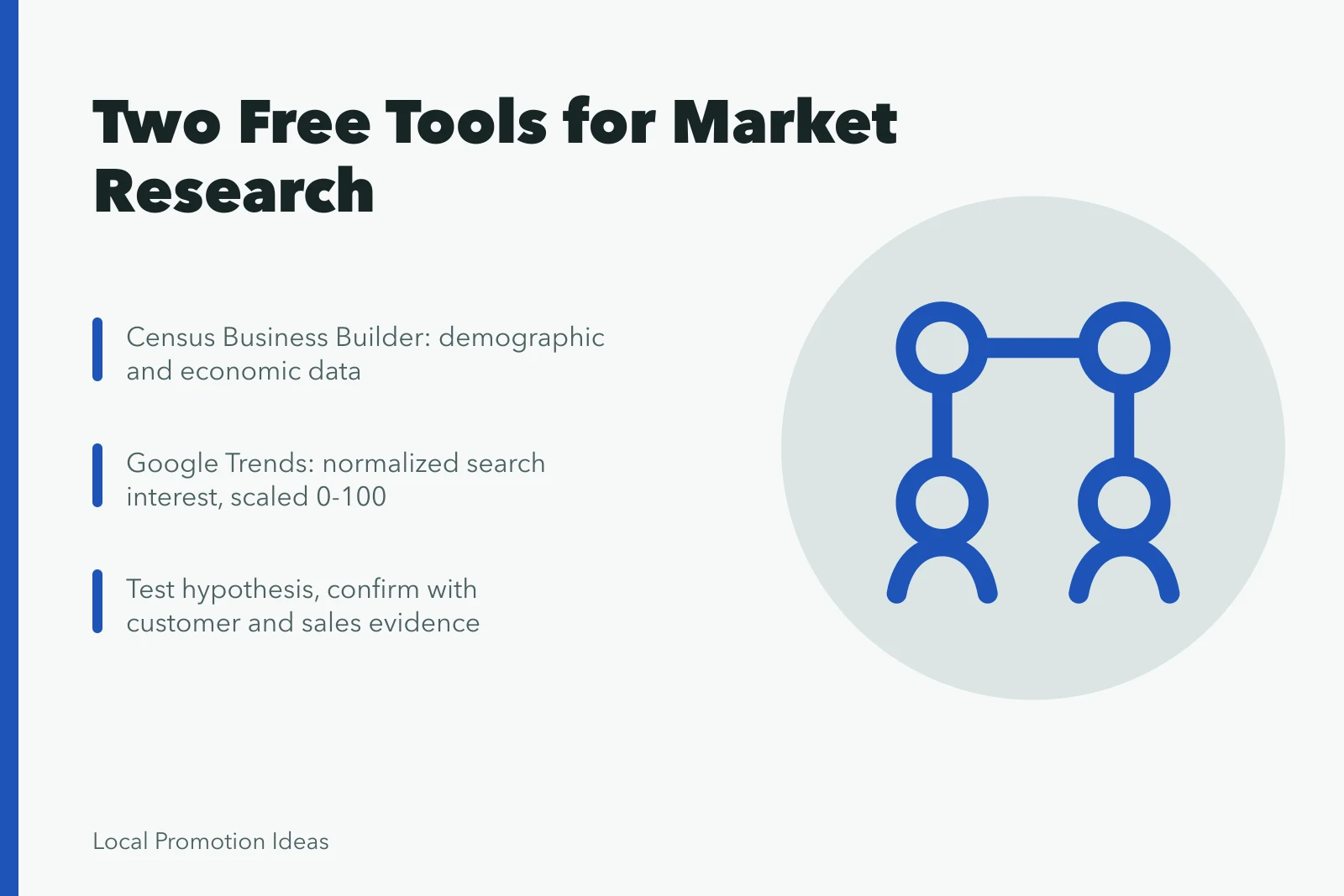
The Census Business Builder help page describes a free suite of demographic and economic data built for small-business and regional users. It answers who lives and trades in a place, and it costs nothing to use.
Use it for market sizing, site selection and competitor density across the United States. Check the industry code, geography and estimate date before you trust a number.
2. Google Trends
Google Trends reports sampled, anonymized, categorized search interest, normalized to a 0 to 100 scale. It is not a poll and not a monthly volume count. It takes second place because the service is free, needs no account, and settles seasonality arguments fast.
Compare terms against topics, set the region, and treat low-volume results as noise.
3. Whitespark
Whitespark builds local citation and review tools, including a citation finder and a review generator. The citation finder sells by subscription, with entry plans typically in the low tens of dollars a month, and citation building is priced per citation.
It suits a business with one to twenty locations that needs its name, address and phone consistent everywhere.
4. Sterling Sky
Sterling Sky is a local search consultancy that publishes public tests of Google Business Profile behavior. Work is quoted per engagement rather than as a monthly retainer, and a single-location local search audit typically runs from several hundred dollars.
It suits an owner who has already fixed the basics and wants a diagnosis.
5. InboxArmy
InboxArmy is a managed email agency offering campaign builds, automation and deliverability work, quoted per project. Managed email programs of this scope typically run from a few hundred dollars a month, and full automation builds reach into the thousands.
It fits a business with a list but no one to write to it.
6. Flowium
Flowium is a Klaviyo-focused email agency serving ecommerce brands, with retainer pricing. Retainers for Klaviyo agencies typically start in the low four figures a month, and the Klaviyo platform fee is billed separately.
It suits a store with real order volume and a retention problem, not a pre-revenue shop.
7. Mailchimp and Klaviyo
Mailchimp's free plan covers 500 contacts and 1,000 sends a month, with paid tiers typically from around $13 a month at that list size. Klaviyo's free plan covers 250 contacts and 500 email sends a month, with paid email plans typically from around $20 a month at 500 contacts.
Mailchimp suits a first list. Klaviyo suits a store that needs revenue attributed to each send. A spreadsheet is the honest choice under a few hundred contacts.
Run one small evaluation
Give each candidate a real job: research one location, test a seasonal hypothesis, trace a qualified inquiry, send a consented follow-up. Score setup time, ongoing owner effort, data export, and full cost.
Keep ownership of domains, profiles, analytics, contacts and consent records. A written small business marketing strategy keeps tool choices tied to outcomes instead of features.
Tool card
| Tool | Good question | Check before buying |
|---|---|---|
| Census Business Builder | Who and what businesses are here? | Code, geography, date; free to use |
| Google Trends | How does interest vary by season? | Term, topic, region; free to use |
| Whitespark | Are listings consistent? | Location count; entry plans in the low tens per month |
| Sterling Sky | Why did rankings move? | Scope of engagement; fixed fee, no retainer |
| InboxArmy, Flowium | Who writes the emails? | Deliverability history; project quote or monthly retainer |
| Mailchimp, Klaviyo | What does a send earn? | Contact tiers; free up to 500 and 250 contacts |
Test the operating burden
The GOV.UK technology selection guidance recommends adaptable choices, data control, security review and ownership-cost analysis. Apply those questions here. They are not product endorsements.
The GOV.UK open standards guidance ties open standards to interoperability and lower supplier dependence. Ask whether your contacts and definitions can leave a tool intact. Before adding any, a small business marketing strategy checklist confirms the process is ready.
Common questions
Do these tools prove market demand?
No. They supply public context and relative interest. Confirm demand with customer interviews, inquiry records and closed sales.
Is a Google Trends score search volume?
No. The 0 to 100 scale is relative interest for the chosen query, place and period, not a monthly count.
Which tool should a one-location business buy first?
None. Fix the Google Business Profile, then buy a tool only when a named task repeats weekly.
What does each tool cost?
Census Business Builder and Google Trends are free. Mailchimp and Klaviyo have free tiers at 500 and 250 contacts, then paid plans typically in the low tens of dollars a month.
Whitespark, InboxArmy, Flowium and Sterling Sky quote per report, project or engagement. Agency retainers of this kind typically run from a few hundred to a few thousand dollars a month, and local-search audits are usually a one-off fixed fee.