
Strategy
Do SBA programs help small firms build pipeline demand in Denver?
Pipeline demand for Denver small firms comes mostly from SCORE and SBDC counseling, federal certifications, and SBA loans that fund outreach.
What to take away
- Pipeline demand rarely arrives from an SBA program by itself; Denver owners get it by pairing counseling or a certification with their own outreach.
- SCORE mentoring and SBDC counseling are free, local, and best used for pricing, targeting and proposal review rather than lead lists.
- 8(a), WOSB, HUBZone and SDVOSB certifications open set-aside contract pipelines, but awards can take months to land.
- Lender Match and SBA loan programs fund the marketing spend behind demand generation, not the demand itself.
- Denver firms report the strongest results when a certification or loan is tied to a named person who owns follow-up.
- SBA help is weakest for firms selling to private buyers in crowded metro markets with no contracting angle.
Which SBA programs Denver firms actually use
The Small Business Administration runs two very different kinds of help. One is free counseling and training. The other is money and contracting status.
Denver owners tend to start with the free side, because it costs nothing and the local network is dense. The SBA's own business guide lays out the full set of programs in one place, from counseling to contracting to loans.
That is why it is usually the first page a Denver owner bookmarks. From there, three local doors take over: the SBA's Colorado District Office in Denver runs the state's contracting and loan programs, the Colorado SBDC network delivers counseling through centers such as the Denver Metro SBDC, and SCORE Denver supplies volunteer mentors drawn from the metro's own industries.
What actually gets used in the metro, in rough order of frequency:
- SCORE mentoring, for pricing, positioning and proposal review.
- SBDC counseling through the Colorado SBDC network, for market research and financial analysis.
- Lender Match and SBA-backed loans, including 7(a) and microloans through a local intermediary.
- SAM.gov registration and the contracting help that comes from the SBA's Colorado District Office.
- The set-aside certifications8(a), HUBZone, WOSB and SDVOSB.
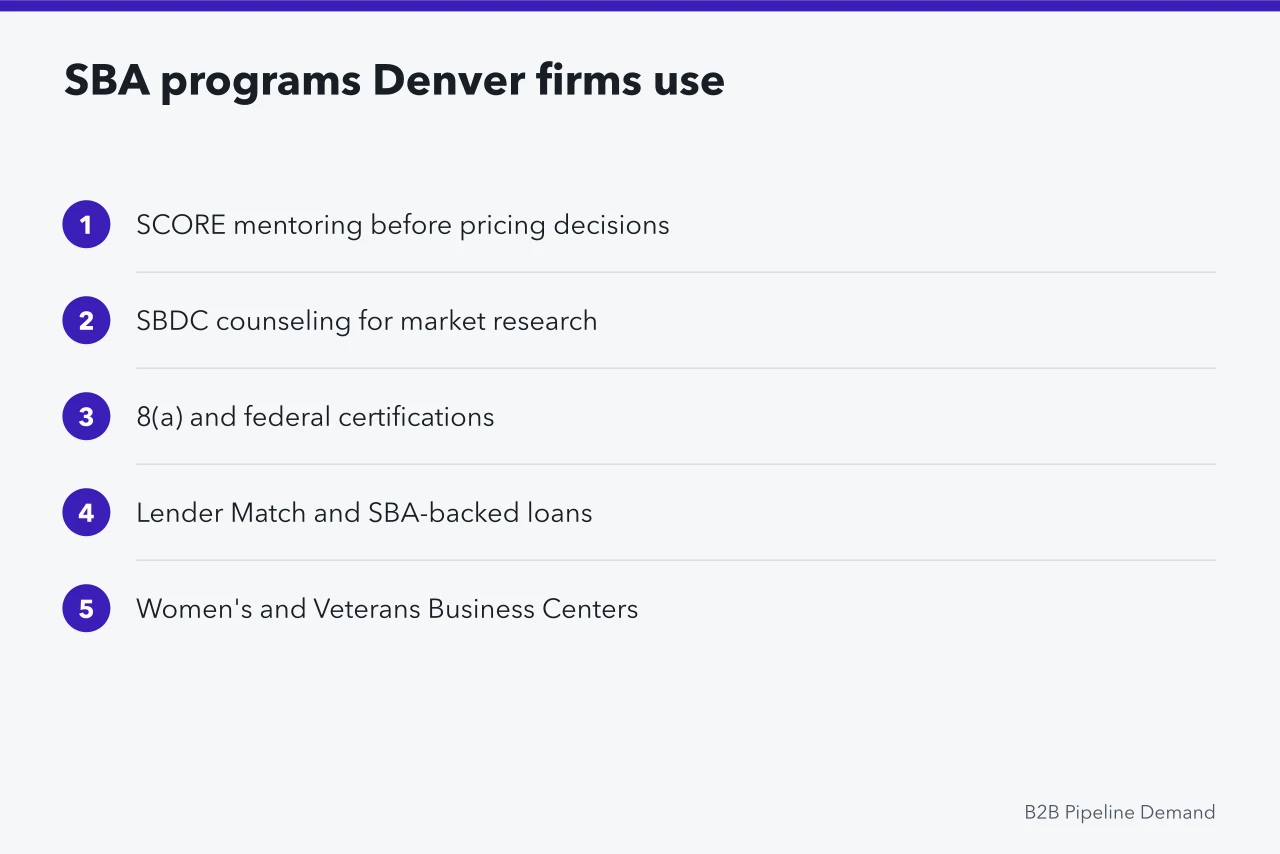
That order matters. Most Denver firms that chase a certification before they have a repeatable sales motion stall out, because the certification only opens a door.
Before you book anything, use the SBA's local assistance directory, which lists district offices, SBDC centers and SCORE chapters by ZIP code. The metro has several, and picking the wrong one wastes a week.
SCORE mentoring and SBDC counseling for pipeline demand
SCORE mentoring is volunteer-based and free. SCORE Denver draws mentors from telecom, software, financial services and professional services, which lines up with the metro's B2B base.
What SCORE mentors are good at: pressure-testing an ideal customer profile, reviewing a proposal, and asking why a deal stalled. What they are not: a source of leads.
SBDC counseling is more structured. The Colorado SBDC network, including the Denver Metro SBDC, runs market research, export help, and financial analysis, and the centers will sometimes pull industry data a small firm cannot afford on its own. That research feeds targeting decisions, which feed pipeline.
Both SCORE and SBDCs are SBA resource partners rather than SBA staff, which is why the quality varies by counselor (Resource partners like SCORE and SBDCs).
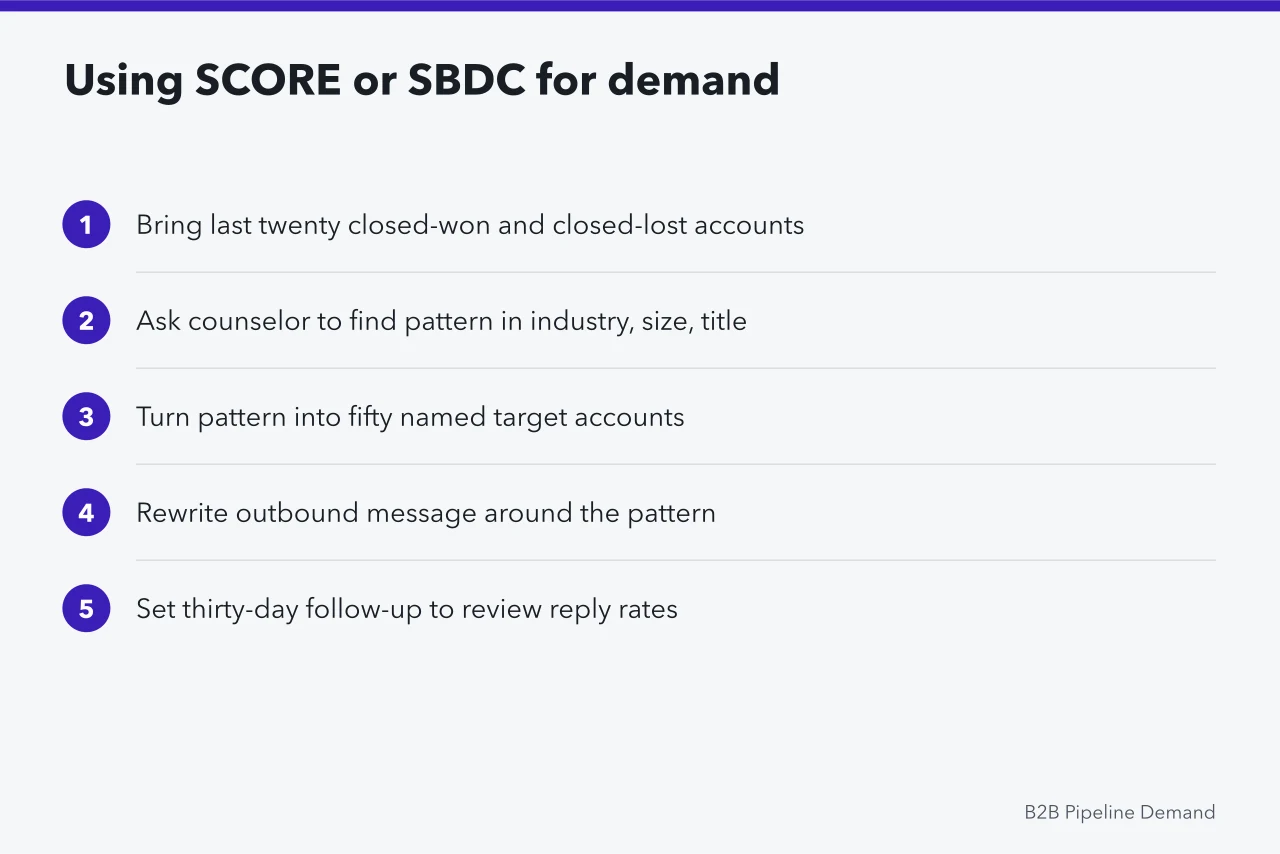
A practical way to use either one for demand work:
- Book a session and bring one real deal that stalled, not a general question about growth.
- Ask the mentor or counselor to pressure-test your ideal customer profile against the buyers you can actually reach.
- Have them review a proposal or pitch you already lost or won.
- Ask the SBDC for industry data on your target accounts, and take the numbers with you.
- Set a follow-up date and report what you changed, so the next session builds on the first.
If you are building that motion from scratch, a practical guide to B2B lead generation covers the same ground in more depth.
Denver's advantage here is concentration. A software firm in RiNo and a consultancy in the Denver Tech Center can both reach a counselor who has sold to the same buyer types.
Federal contracting certifications: 8(a), WOSB, HUBZone, SDVOSB
This is where SBA programs most directly create pipeline, because set-aside contracts are pipeline by definition.
The four certifications a Denver firm is most likely to weigh:
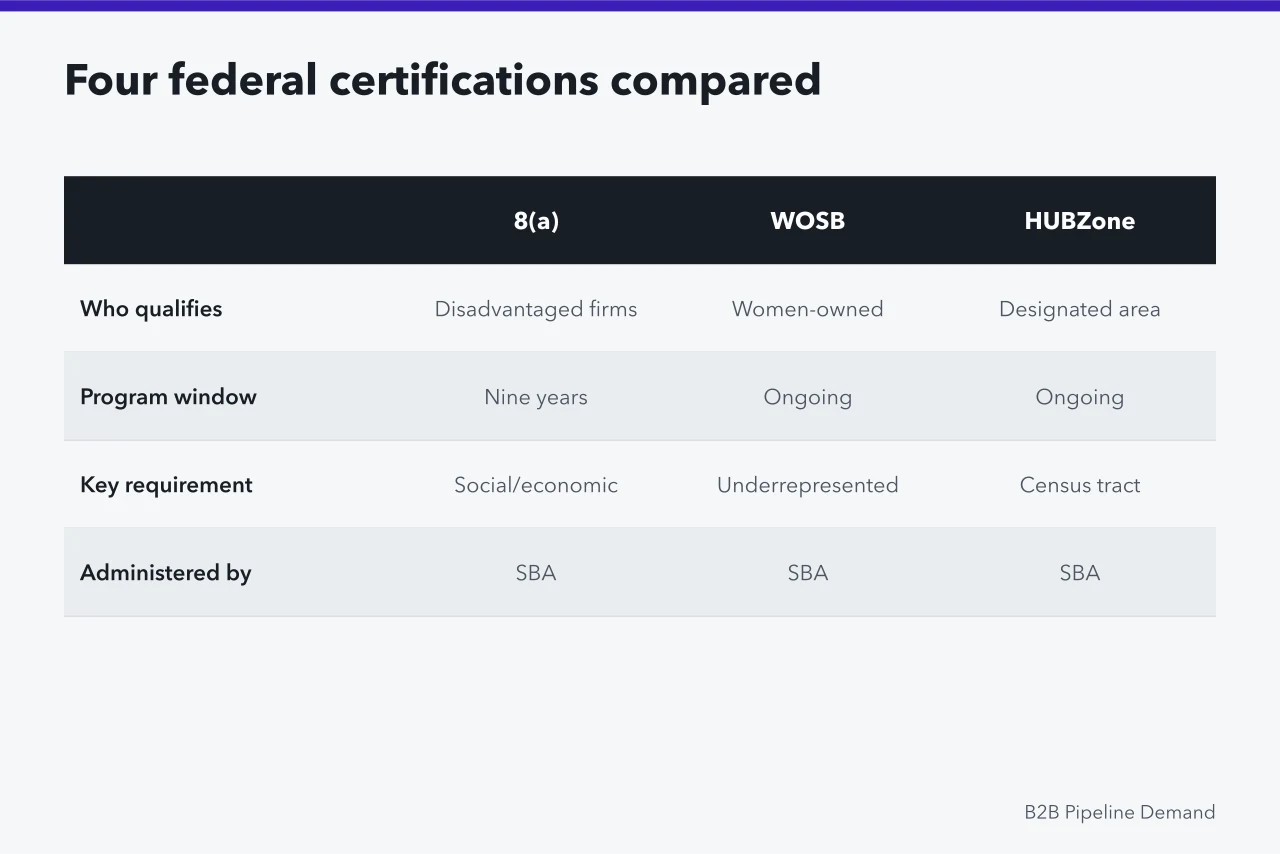
Each certification is administered by the SBA and each has its own eligibility test. 8(a) is for firms owned and controlled by socially and economically disadvantaged individuals. WOSB is for firms owned and controlled by women. HUBZone turns on where your principal office sits and where your employees live. SDVOSB is for firms owned and controlled by a veteran with a service-connected disability. Applications run through the SBA's Certify portal, and the rules are specific enough that you should read them before spending a month on paperwork.
Denver specifics matter. HUBZone eligibility depends on census tract, and tracts change. Parts of the metro qualify and neighboring blocks do not, so check the SBA's HUBZone map for your actual address rather than assuming.
Certification also does little without a contracting plan. The firms that get awards typically:
- Register in SAM.gov and keep the profile current.
- Track spending on USAspending.gov to find agencies already buying their service.
- Attend agency small business events, including those run around the Denver Federal Center in Lakewood.
- Team with a prime contractor on a smaller task before bidding alone.
Certification timelines run long. A firm that starts in the fall should not expect a set-aside award to carry the next quarter.
SBA loan programs that fund demand generation
SBA loans do not generate pipeline. They pay for the people and programs that do.
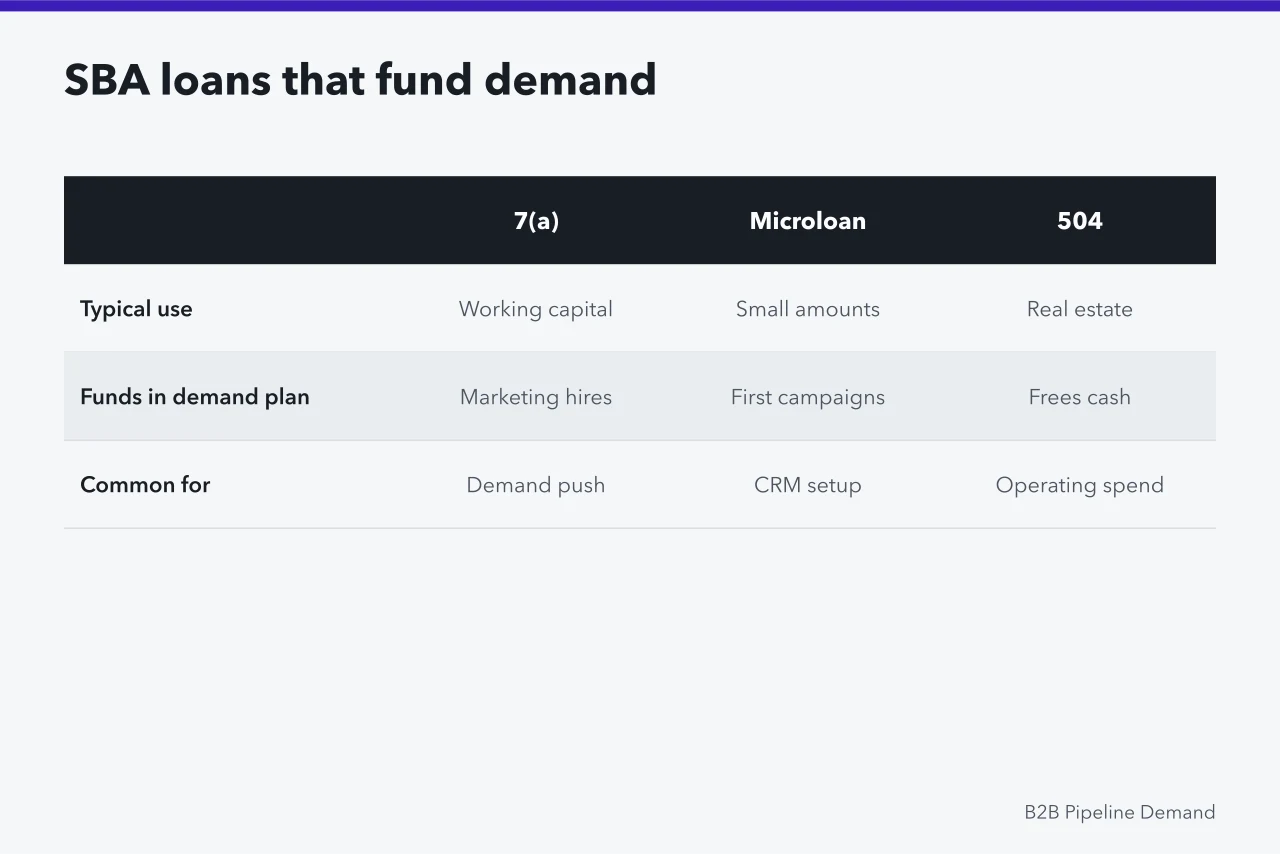
The main options for a Denver small firm:
- 7(a)the general-purpose loan, delivered by participating banks, used for working capital, equipment and acquisition.
- Microloansmaller amounts delivered through a local intermediary, often the first loan a young firm takes.
- 504a bank loan paired with a long-term, fixed-rate debenture, made through a Certified Development Company and used mainly for real estate and equipment.
SBA loan programs
Typical use
- 7(a)
- Working capital, equipment, acquisition
- Microloan
- Small amounts through intermediaries
- 504
- Real estate and heavy equipment
- Community Advantage
- Smaller loans via mission lenders
What it funds in a demand plan
- 7(a)
- Marketing hires, agency retainers, event booths
- Microloan
- First paid campaigns, CRM setup
- 504
- Frees cash for operating spend
- Community Advantage
- Payroll for a first sales hire
A 7(a) line used for working capital is the most common way Denver firms fund a demand push, because it covers payroll during the months before campaigns pay back.
Rates and terms follow the program, not a single SBA rate card. 7(a) rates are negotiated with the lender but capped by SBA rules tied to a published base rate, and the repayment schedule runs shorter for working capital and longer for real estate. Microloan rates are set by the intermediary inside SBA caps. On a 504 the bank portion is priced by the bank while the debenture carries a long-term fixed rate, and the SBA charges a guaranty fee on 7(a) loans.
Be honest about the math. If a campaign costs a set amount per month and your average deal takes months to close, the loan has to cover the gap, not just the campaign. Skipping that calculation is how firms end up with debt and no pipeline.
Before borrowing, it helps to know what similar companies spend on marketing at your size, since lenders will ask how the money gets used. Published budget benchmarks by company size give you a defensible number.
A short checklist before you sign:
- Campaign cost per month and expected months to first closed deal.
- Average deal size and current win rate.
- Payroll covered through the payback window.
- A named owner for follow-up on every lead.
- A stop date if reply rates stay flat.
- Repayment schedule that survives a slow quarter.
Lender Match and alternative funding options
Lender Match is the SBA's free tool that connects a borrower with participating lenders, usually within a couple of days (Lender Match tool for small business financing).
It is a matching service, not a lender and not an approval. You still submit full documentation and still get underwritten.
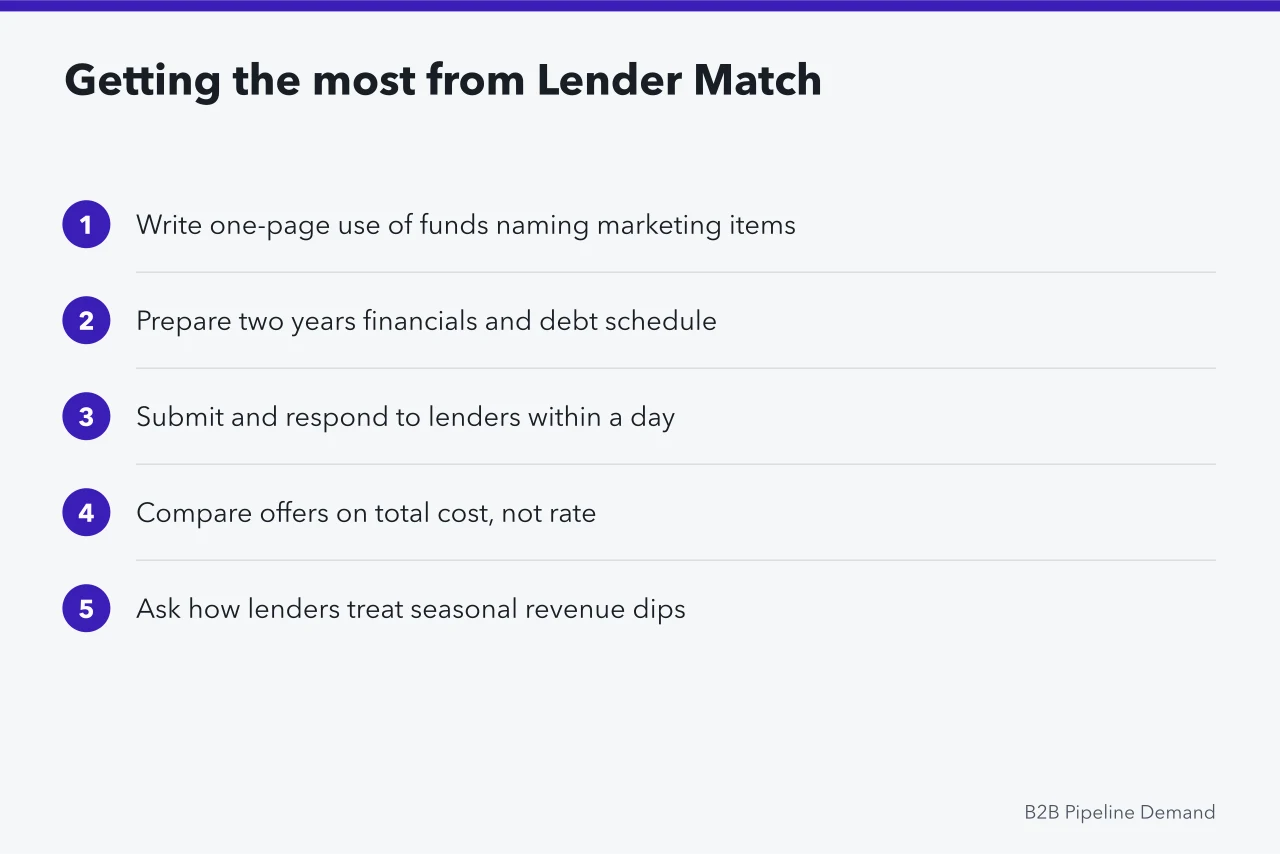
How Denver owners get the most from it:
- Know your numbers before you submituse of funds, repayment source, and current financial statements.
- Request a realistic amount for the demand plan you can actually execute.
- Compare the responses on rate, fees, and whether the lender already works with your industry.
- Ask each lender which SBA program it would use, since a 7(a) loan and a microloan through an intermediary are different products.
- Get the repayment schedule in writing before you sign anything.
Alternatives when a bank says no: Colorado credit unions with business lending arms, such as Bellco; CDFIs serving the Front Range, such as the Denver-based Colorado Enterprise Fund; revenue-based financing; and equipment financing tied to a specific asset.
Smaller Denver firms often start with a microloan through a local intermediary before applying for a 7(a). It builds a repayment record that makes the larger loan easier.
Whichever route you take, the money should map to a funnel with b2b demand generation metrics that show which stages actually move, or the spend leaks.
What to expect from SBA-supported demand work
Results vary by model, so treat these as patterns rather than guarantees.
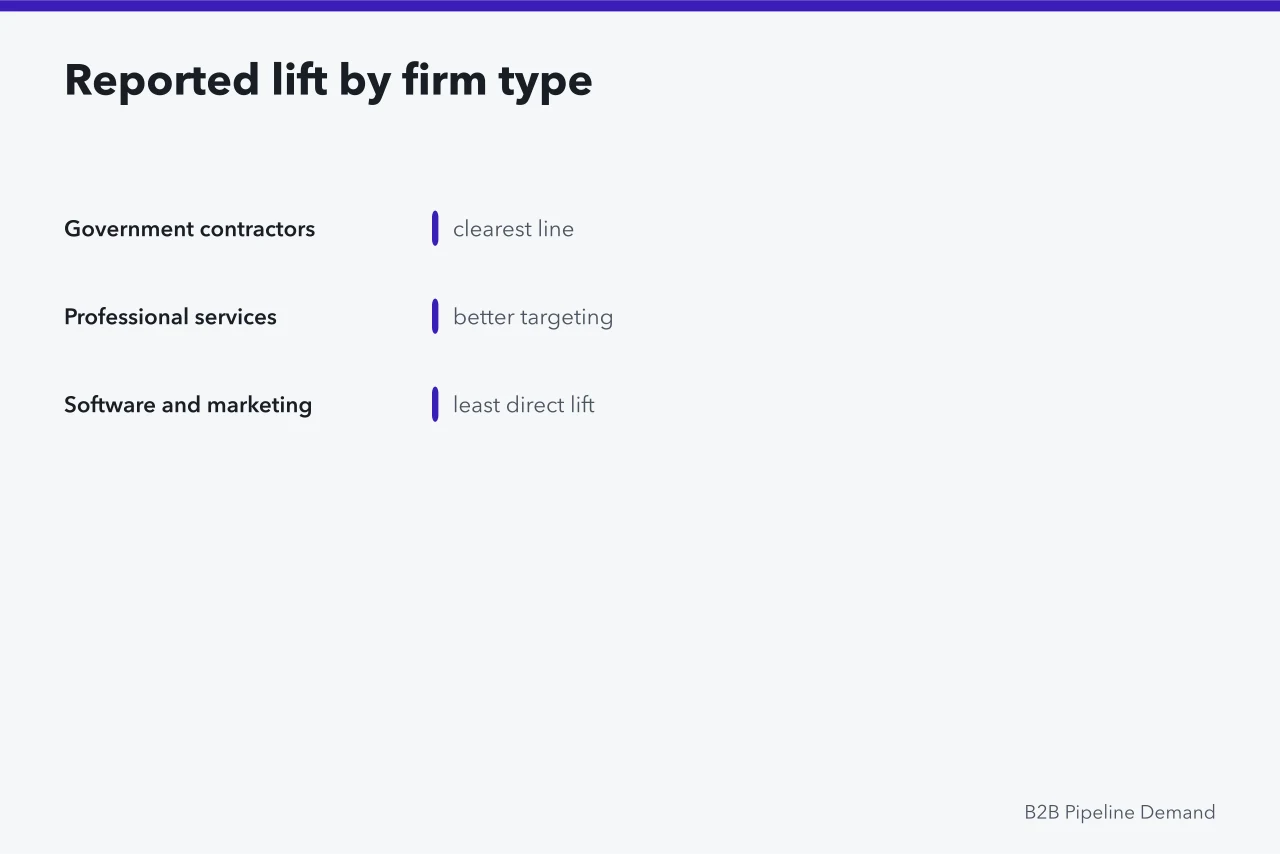
Government contractors see the clearest line from program to pipeline. A certification leads to set-aside solicitations, and a won task order leads to follow-on work. The lag is long, often several quarters.
Professional services firms that use SBDC research get better targeting, meaning fewer but better-fit conversations. The counseling rarely produces closed revenue by itself.
Software and marketing services firms get the least direct lift from SBA programs, because their buyers are private companies not influenced by set-aside rules.
A worked example with round numbers. A ten-person consultancy uses SBDC research to narrow from all Colorado mid-market manufacturers to forty named accounts in the metro. It uses a 7(a) line to fund one sales hire and a modest outbound program.
Over two quarters it books roughly a dozen first meetings and closes a few, with most of the value coming from the narrowing, not the loan.
The common thread is focus. Programs that force a firm to define its buyer tend to help. Programs that only supply money or a badge do not.
If reply rates stay flat after a quarter, the problem is usually the offer or the list. A disciplined pipeline review separates real interest from polite interest.
Where SBA programs help least
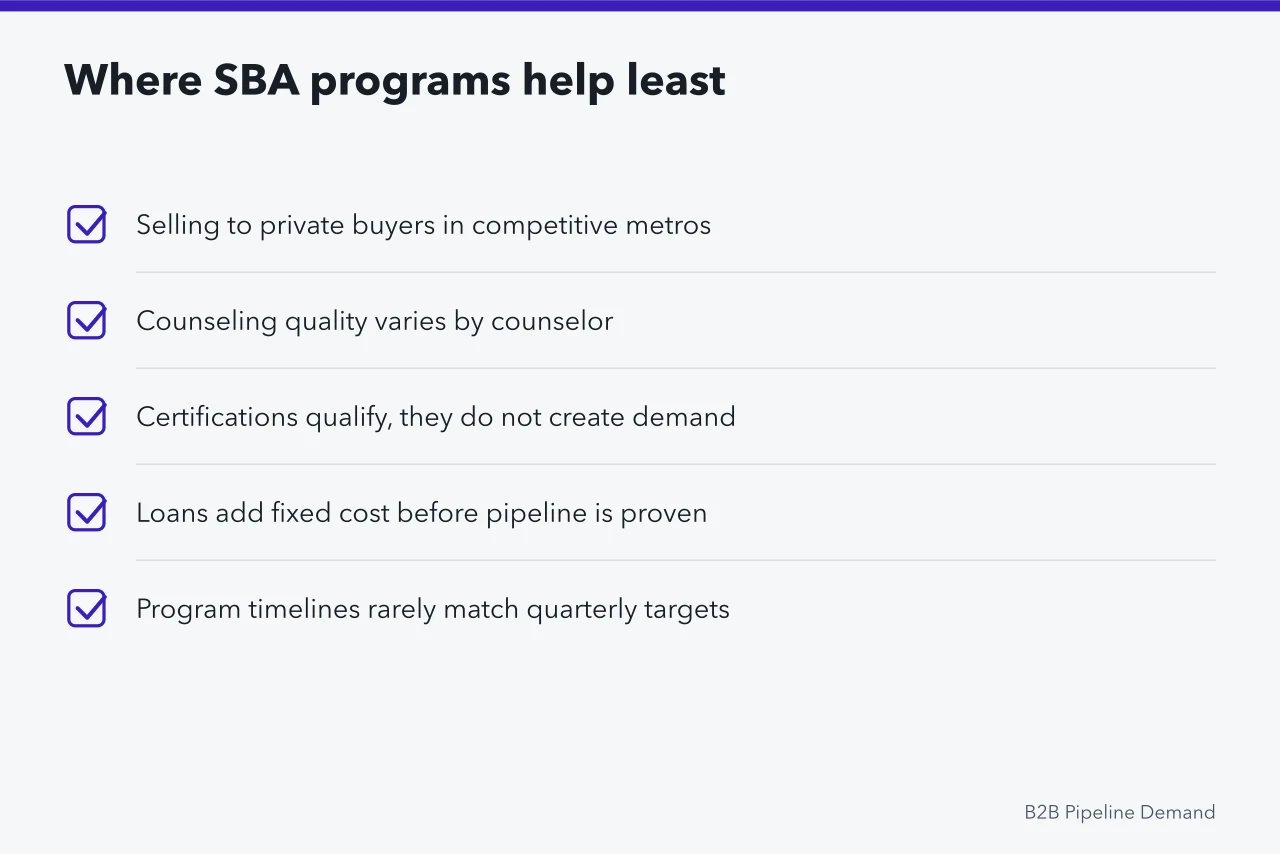
SBA programs are weak for firms selling to private buyers in competitive metro markets. Denver has a deep pool of B2B tech and services buyers, and none of them care about your certification status.
Other limits worth knowing:
- Counseling quality varies by counselor, because SCORE and the SBDCs are SBA resource partners rather than SBA staff.
- A certification changes nothing when your buyers are private companies.
- A loan-funded campaign still has to pay for itself out of gross profit.
- No SBA program shortens a federal award cycle that runs in quarters.
A Denver firm with no government contracting ambition and no funding need should treat SBA programs as a light supplement, not a channel.
Spend the same hours on list quality, message testing and follow-up discipline instead. That is where b2b pipeline velocity calculation usually pays back fastest.