Careers
Part of Getting Small Business Marketing Strategy Right the First Time
Small Business Marketing Strategy Checklist: Every Item, With the Reason Behind It
Small business marketing strategy checklist covers outcomes, customers, offers, channels, economics, evidence, accessibility, security, capacity, and tests.
What to take away
- Complete the checklist against a real offer, customer journey, sales record, budget, and service process rather than a planned channel calendar.
- Protect accessibility, customer data, account recovery, claims evidence, consent records, and supplier access before buying more reach.
- Close a gap only when the new customer, financial, operational, or safeguard evidence can be demonstrated and reviewed.
A small business marketing strategy checklist should force decisions before tasks are scheduled. Complete it with the owner and the people responsible for sales, delivery, service, finance, and customer data. Record evidence, assumptions, exclusions, owners, and review dates.
Business and market
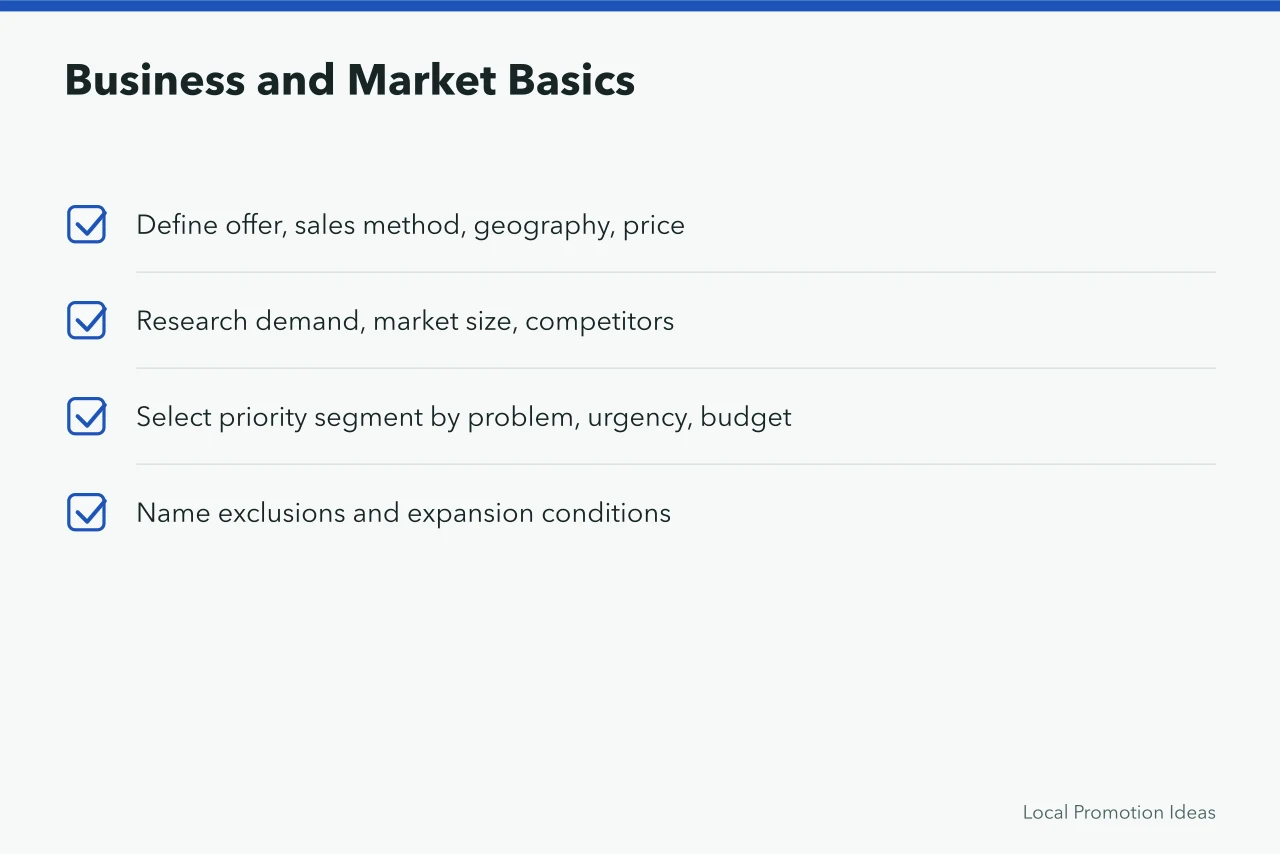
- Define the offer, sales method, geography, price, variable cost, payment timing, repeat pattern, delivery limit, cash constraint, and one primary business objective.
- Research demand, market size, economic conditions, location, saturation, pricing, customer language, search behavior, sales records, reviews, competitors, alternatives, and lost sales.
- Select a priority segment by problem, buying situation, urgency, service fit, budget, authority, evidence need, and behavior; name exclusions and expansion conditions.
Position and offer
- Write the customer's trigger, workaround, desired outcome, objections, risk, decision criteria, trusted evidence, people involved, buying path, and reason to delay.
- State the relevant category, distinctive value, reason to believe, and boundary; test whether customers understand it and operations can deliver it consistently.
- Clarify deliverable, outcome, process, timing, price method, eligibility, limitations, responsibilities, support, policies, guarantee, proof, and next step.
Journey and channels
The U.S. Department of Justice's web accessibility guidance describes barriers including contrast, color-only cues, text alternatives, captions, and forms. Keyboard access and reporting problems are covered.
It addresses ADA responsibilities for state and local governments and businesses open to the public, so obtain qualified advice for business, content, jurisdiction, and current requirements. Accessible identity choices shape positioning and proof covered in small business branding strategy for 2027.
- Map discovery, evaluation, purchase, preparation, delivery, support, repeat, and referral with questions, evidence, friction, owner, data, and handoff at each stage.
- Assign discovery, evaluation, conversion, service, retention, or referral roles to a maintainable channel mix; document why each channel fits the chosen customer.
- Protect owned accounts, domains, customer lists, consent records, analytics, creative files, access recovery, and exports, including when an agency performs the work.
Economics and evidence
NIST's Small Business Cybersecurity Corner collects current resources on accounts, authentication, phishing, data, devices, networks, cloud services, suppliers, incidents, recovery, and training. NIST notes that listed commercial entities are not endorsements. Use the materials to test safeguards with appropriate technical and legal help, not as a product certification.
- Budget owner and employee time, agencies, production, media, software, fees, fulfillment, service, analysis, learning, and contingency; define capacity and stop thresholds.
- Connect the business objective with outcomes, leading indicators, cost, quality, and capacity; define events and combine analytics, customer reports, sales, and financial evidence.
- Write each experiment's problem, hypothesis, change, audience, primary measure, guardrail, duration, budget, limitation, and decision rule before launch.
Review claims, disclosures, reviews, consent, and privacy with qualified local advisers where needed. Review accessibility, intellectual property, promotions, pricing, and regulated-product obligations with them. Stress-test the plan: low demand, high demand, staff absence, supplier delay, platform outage.
List what will not be funded in the next 90 days. A written plan names the small business marketing strategy mistakes that trigger legal and operational trouble.
Checklist evidence register
| Area | Minimum evidence | Decision |
|---|---|---|
| Market | Demand, customer, competitor, position, exclusions | Focus or research |
| Offer | Proof, price, contribution, capacity, limits | Test, repair, or stop |
| Channels | Role, owner, handoff, access, accessibility | Use, condition, or reject |
| Learning | Baseline, outcome, guardrail, cost, review | Stop, fix, keep, or scale |
Record the gate result
The W3C Privacy Principles statement gives web-system designers shared privacy concepts and warns against shifting privacy work to individuals. Apply it to small business marketing strategy checklist, then review the governing law and configuration.
The CISA software acquisition fact sheet covers development practice, supply-chain exposure, deployment, and vulnerability management. Add those government-acquisition questions to a small business marketing strategy checklist review without treating them as local approval. Budget lines for software, security, and compliance belong in small business marketing budgets before any campaign starts.
Common questions
Who should complete the checklist?
Include the owner and the people responsible for sales, delivery, service, finance, customer data, technology, accessibility, security, and legal or regulatory review as relevant.
Does every checklist item need a yes answer?
No. Mark an item not applicable only with a reason. Give each material gap an owner, consequence, interim control, due decision, and verification method.
When should the checklist be repeated?
Repeat it after each planning cycle and after a material change in the customer, offer, location, pricing, capacity, supplier, channel, data use, technology, law, or operating risk.