Costs
Part of Getting Small Business Marketing Strategy Right the First Time
Choosing Before Planning Anchors a Sound Marketing Strategy
Small business marketing strategy best practices connect customer focus, positioning, channel roles, economics, capacity, proof, data security, and learning.
What to take away
- Make customer, position, offer, channel, economic, and exclusion choices before building a campaign calendar.
- Connect every acquisition plan with response, inventory, booking, fulfillment, service-quality, and workload guardrails.
- Keep claims, disclosures, customer data, account access, evidence, and experiments usable, secure, reviewable, and owned by the business.
Small business marketing strategy best practices concentrate scarce attention on a customer problem the business can solve profitably. They make channel and spending choices easier, protect delivery quality, and create a repeatable learning rhythm. Start with evidence and economics, then choose tactics.
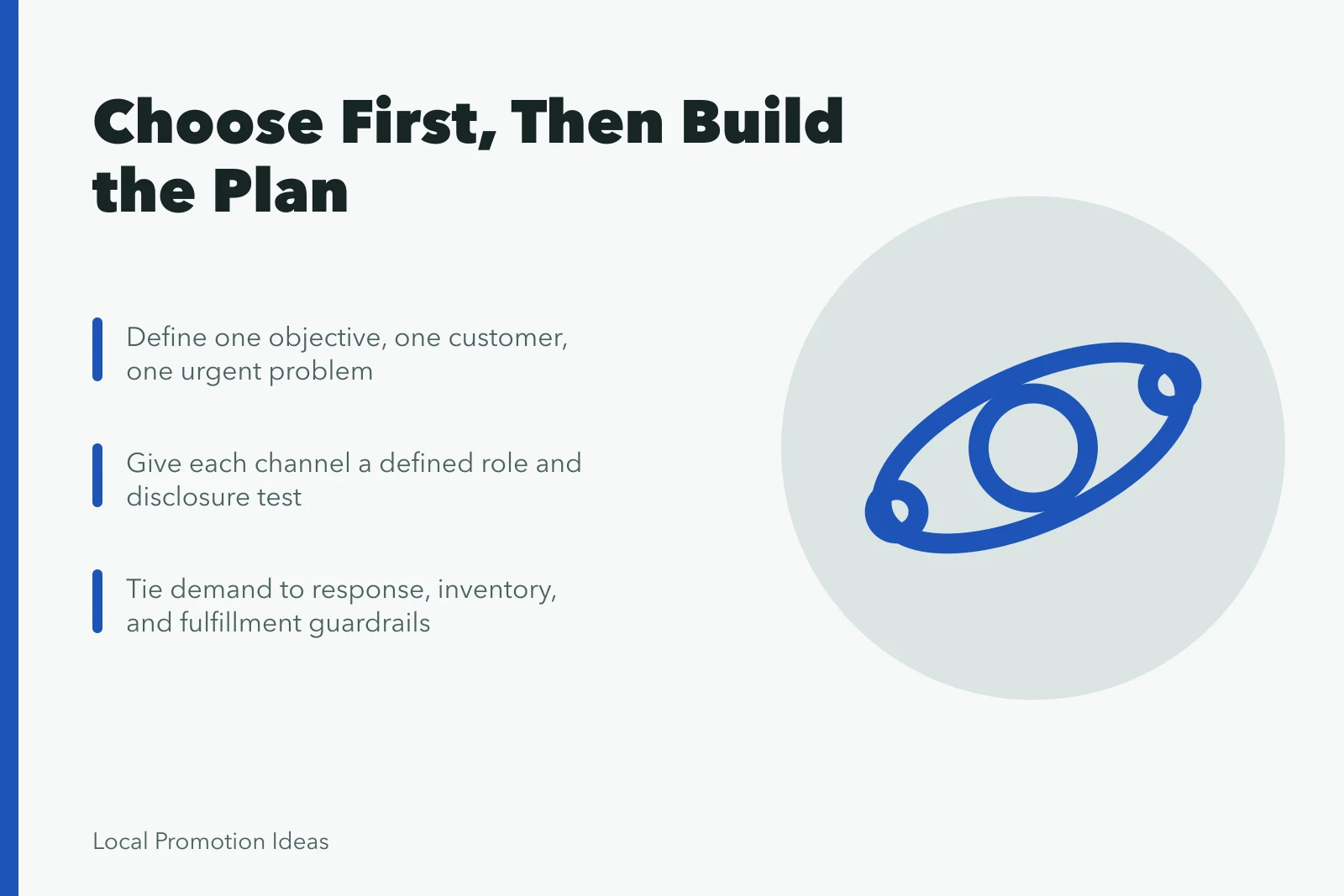
Choose before planning
Choose Before Planning
- One business objective
- One priority customer
- One urgent problem
- Relevant competitive frame
- Distinctive position
- Offer the business can deliver
- Name exclusions and unfunded items
Mix public and direct research
Use official demographic and economic data for market context, then speak with customers and lost prospects about triggers, alternatives, decision criteria, objections, and outcomes. Inspect search, sales, support, review, and competitor evidence. Separate facts, statements, interpretations, and unresolved assumptions.
Give channels defined roles
The FTC's digital disclosure guidance explains that required disclosures should be clear and conspicuous in the context of the claim, device, placement, and customer path. The 2013 U.S. guidance should be read with current rules and qualified advice, but it remains a useful test against hiding material information behind weak links or inaccessible presentation.
Choose a maintainable mix covering discovery, evaluation, purchase, service, retention, and referral. Assign one primary job, owner, budget, capacity, and proof of success to each channel. Repair the destination and follow-up before paying for more reach. Preserve business ownership of accounts, data, domains, and creative files.
Connect demand with operations
The FTC's Start with Security guide draws practical lessons from U.S. enforcement matters about minimizing data, restricting access, authentication, secure storage and transmission, service providers, updates, incidents, and disposal. The cited settlements are context, not universal findings against every business; adapt safeguards to actual data and risk.
Set response, inventory, booking, fulfillment, wait-time, service-quality, and workload guardrails before a campaign. Budget owner time, staff, suppliers, production, software, media, analysis, and contingency. Pause or narrow acquisition when the business cannot deliver the promise.
Use proof responsibly
Collect demonstrations, qualifications, transparent policies, verified examples, and honest customer feedback that answer real buying questions. Keep substantiation before publishing claims. Disclose material connections and avoid manipulated reviews or false urgency. The FTC's U.S. guidance requires truthful, non-deceptive, supported, and fair advertising; local rules vary.
Learn in 90-day cycles
Build baseline, select one consequential bottleneck, and run a bounded test with a hypothesis, primary measure, and quality guardrail. Add budget, duration, and stop rule, then reconcile platform signals with customer, sales, operational, and financial evidence.
Review monthly, make concentration decisions quarterly, and preserve weak results for future learning. A small business marketing strategy checklist keeps baseline, bottleneck, and stop rule in one reviewable place.
Keep the strategy to one page and the evidence in linked records. Ask a customer to explain the promise, an employee to test delivery, and a financial adviser to challenge the economics. Simplicity should come from strong choices, not from ignoring cost, risk, or capacity.
Best-practice operating card
| Practice | Evidence | Failure signal |
|---|---|---|
| Choose | Customer, position, offer, exclusions | Calendar drives strategy |
| Connect | Channel, handoff, cost, capacity, service | Demand harms delivery |
| Protect | Claims, disclosure, access, data, recovery | Hidden or uncontrolled risk |
| Learn | Baseline, test, guardrail, decision log | Activity without a choice |
Assign the practice
The NIST Privacy Framework starting guide outlines a voluntary process for identifying and managing privacy risk. Use it to assign data and response owners for small business marketing strategy best practices; it is not legal clearance.
The CISA business-system logging guidance explains how event records support security review. Preserve appropriate small business marketing strategy best practices access, change, failure, and correction records without claiming that logging validates a metric.
Common questions
What should a small business do first?
Define one business objective, one priority customer and problem, a distinctive position, a deliverable offer, its economics, capacity, evidence, exclusions, and the first decision to test.
Should every channel be active?
No. Assign clear jobs to a maintainable mix and pause channels that lack a defined customer role, owner, evidence, or affordable operating capacity.
How should results be reviewed?
Reconcile platform signals with customer, sales, operational, and financial records. Decide what to stop, fix, keep, or scale and preserve weak or negative findings.