Strategy
Practical event marketing examples worth borrowing for less
Named event marketing examples, from SBA matchmaking to REI classes, plus what each format costs and how to borrow the setup for a small budget.
What to take away
- Named formats a small business can copy for under $100 exist at every scale: SBA matchmaking, SCORE workshops, library talks, 1 Million Cups, store classes and farmers market demos.
- The table below puts a cost driver on every row, so you can price a copy before you commit.
- A $300 event that produces 20 qualified conversations costs $15 per lead. Put that against your own cost per lead.
- Staff time, insurance and follow-up decide whether the event paid off.
- Book the room, the insurance and the promotion at least six weeks before a first run.
Named examples, with a cost driver on every row
Every entry below is a program somebody already runs at low cost. Copy the mechanism, not the branding. For the same reasoning applied to written material rather than events, Small Business Content Marketing Examples takes named campaigns apart line by line.
| Example | Who runs it | Borrowable detail | Cost driver |
|---|---|---|---|
| SBA business matchmaking | SBA district offices | Pre-scheduled buyer meetings, 10 to 20 minutes each | Free to attend; the office funds room and staff; your travel and one-sheets typically cost under $50 |
| SCORE workshops | SCORE, an SBA resource partner | Free workshops plus one-to-one mentoring | Free; mentor time is donated; you spend the prep hours |
| 1 Million Cups | Ewing Marion Kauffman Foundation | Two founders speak for six minutes each, then take questions | Free; the venue donates the room; a coffee hat pass typically runs $20 to $40 a week |
| CreativeMornings | Volunteer city chapters | Monthly Friday breakfast talk, one speaker for about 20 minutes | Free; venue and breakfast are donated; the cost sits with the chapter |
| REI Co-op classes | REI stores | Skills sessions built around a product category | Free to a typical $75; membership is $30 once |
| Home Depot Kids Workshop | The Home Depot | First Saturday, 9 a.m. to noon; children build and keep a project | Free; the store absorbs kit materials, a typical $2 to $5 each |
| Apple Today at Apple | Apple Stores | Photography, coding and music sessions with sign-up caps | Free; Apple staffs it; you pay only the trip |
| Free Comic Book Day | Independent comic shops | Giveaway comics plus creator signings | Free to visitors; the shop buys stock at a typical wholesale range of $0.25 to $0.60 a comic |
| Brooklyn Museum First Saturdays | Brooklyn Museum | Free evening of music, talks and gallery access | Free; the museum funds it; your cost is the trip |
| Patagonia Worn Wear repairs | Patagonia | Free repairs at store and tour stops | Free; Patagonia funds the staff and tour logistics |
| Ferry Plaza market demos | CUESA, San Francisco | Market to Table cooking demos beside the stalls | Stall fees typically $25 to $75 a day, sometimes plus a share of sales |
| Farm Science Review | Ohio State University Extension | Three days each September in London, Ohio | Advance tickets typically around $10; children free |
The SBA's events listing works as a format study, because it sorts business events by topic, location and delivery. You still need your own audience research and measurement.
Pricing a copy: five lines and one sum
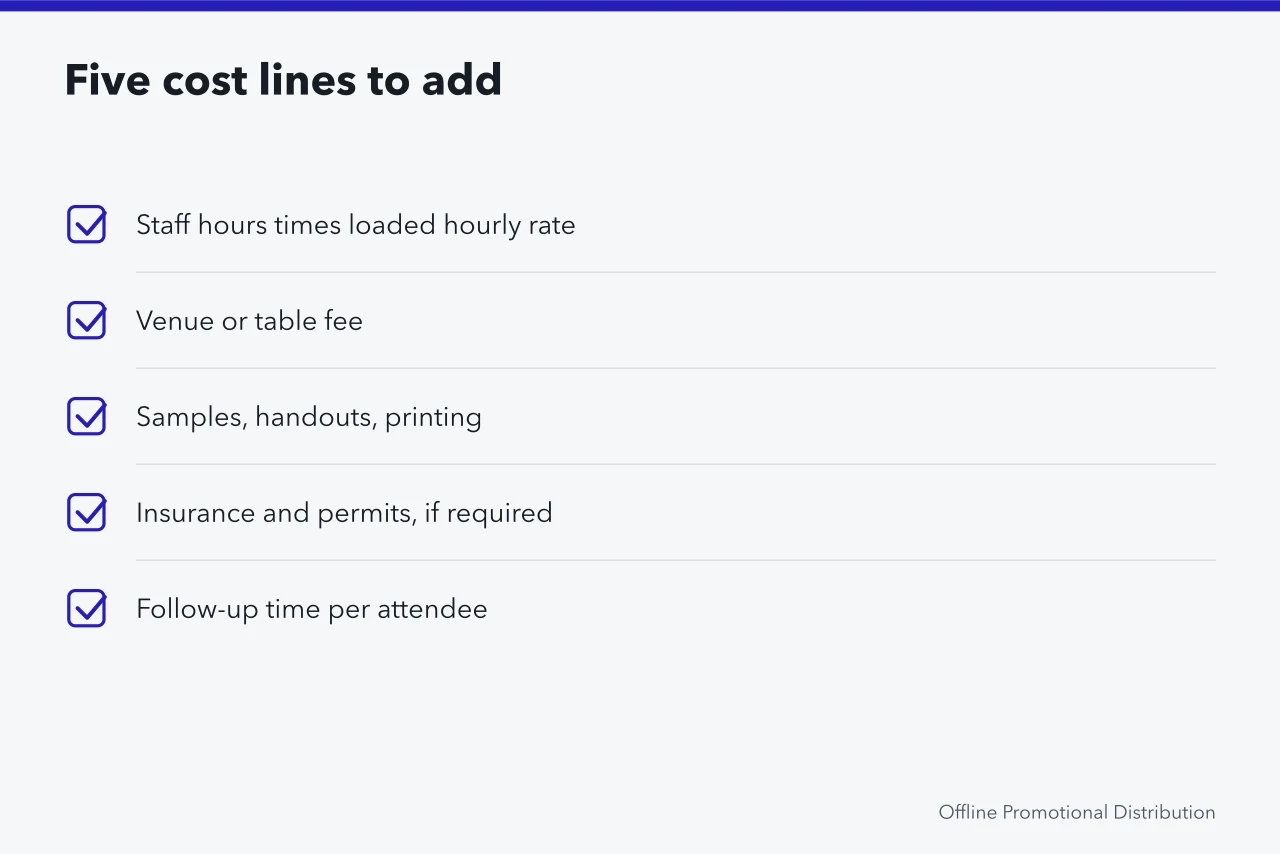
Add these before you commit.
- Staff hours times a loaded hourly rate.
- Venue or table fee.
- Samples, handouts and printing.
- Insurance and permits, if required.
- Follow-up time per attendee.
A one-day event liability policy typically runs $75 to $250. Two hundred and fifty flyers usually cost $50 to $150. Follow-up is where the cost hides, so plan the messages with the Small Business Email Marketing Checklist before the event, not after.
Worked sum: $120 of staff time, a $60 table fee, $60 of printing and a $60 share of the policy comes to $300. At 20 qualified conversations, that is $15 per lead. Compare it with a printed coupon drop, since mail coupons are the local benchmark most owners already track.
Example: rebuilding Free Comic Book Day on a shop budget
A small shop ordering 100 giveaway comics at a typical wholesale range of $0.25 to $0.60 each spends $25 to $60 on stock. Two extra staff for six hours at about $18 an hour adds roughly $216. Budget $100 for a local creator's table and travel.
That puts the day near $340 to $380 for the organizer. Shops run it because the queue walks past the back-issue racks, and the email list is the durable asset.
Promotion is the part shops skip. The Small Business Social Media Case Studies show what a small account can post without ad spend, which matters when you have three weeks and no budget.
Permits, access and safety before you spend
Yosemite National Park's special use permit process applies to that park alone, and it shows how early a federal site wants paperwork. City sidewalks, private lots and storefronts have their own rules. Confirm with whoever owns the ground.
- Ask whether the venue's policy covers your activity, or buy a one-day certificate.
- Keep accessible routes clear; a table across a doorway blocks them.
- Publish price, schedule, eligibility and how you will use sign-up data.
- Walk the attendee route at the real hour, queue included.
- Drop any demonstration nobody has checked for safety.
Turning a borrowed format into a test case
- Name the mechanism. From 1 Million Cups, that is six minutes without slides, then questions.
- Put a local figure on it. Swap REI's $75 class ceiling for your own room capacity and staff hours.
- Write the failure case. Without two staff hours for follow-up, the Free Comic Book Day model does not transfer.
- Book venue, insurance and promotion at least six weeks ahead for a first run.
- Measure one outcome, not attendancequalified conversations, bookings or repairs completed.
If the event builds a list, check follow-up rates against the Small Business Email Marketing Benchmarks before you call the format a dud.