Rules
Part of Small Business Social Media: A 90-Day Operating Reset
Eight Social Media Patterns, from Services to Retention
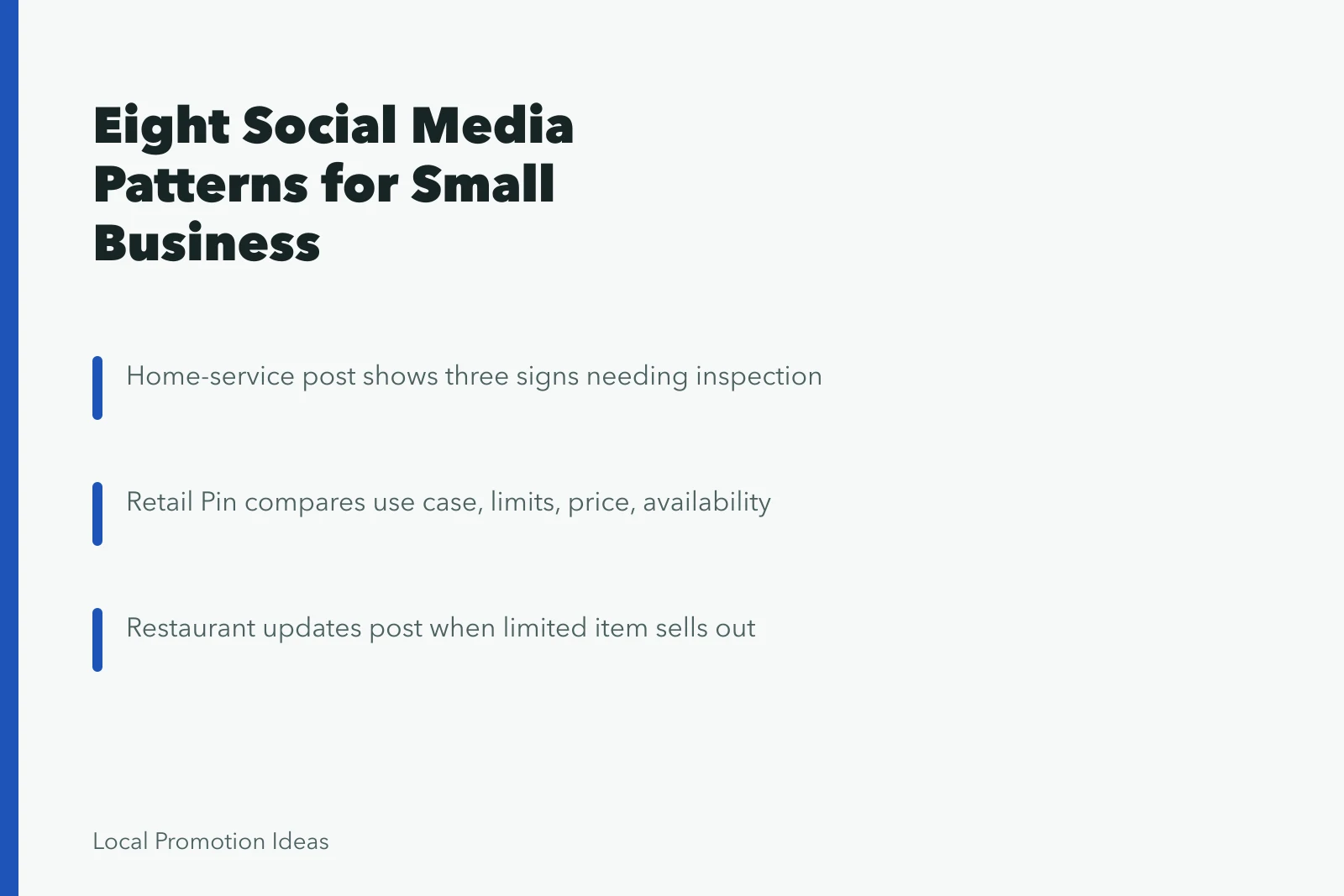
Small business social media examples show eight patterns for services, retail, professional firms, restaurants, support, events, employees, and retention.
What to take away
- Eight patterns carry a customer from a first problem to a repeat purchase.
- Each needs a platform that fits, a sample caption, a safeguard and one measure.
- Copy the structure, not the wording.
- Run one new pattern a week until an owner, a reviewer and a response plan are named.
The brands below post in public: Roto-Rooter, REI, H&R Block, Chipotle, Zappos, Eventbrite, HubSpot and Mailchimp. None hands over a reusable script. Account setup comes first, and Small Business Social Media for the Careful Reader covers it.
Eight patterns with the platform each one suits
Platform
- Home-service diagnosis (Roto-Rooter, Mister Sparky)
- Facebook, Instagram Reels, 30 to 60 seconds
- Retail comparison (REI, Home Depot)
- Instagram carousel, 3 to 5 images
- Professional briefing (H&R Block, LegalZoom)
- LinkedIn, email list
- Restaurant availability (Chipotle, Sweetgreen)
- Instagram Stories, TikTok under 15 seconds
- Support question series (Zappos, Chewy)
- Facebook, YouTube Shorts, captions on
- Local event guide (Eventbrite, Meetup)
- Facebook Events, Instagram
- Employee introduction (HubSpot, Buffer)
- LinkedIn, Instagram
- Retention reminder (Mailchimp, Constant Contact)
- Email, SMS
Measure after 14 days
- Home-service diagnosis (Roto-Rooter, Mister Sparky)
- Booked inspection calls from the post link
- Retail comparison (REI, Home Depot)
- Product page visits, questions that name the post
- Professional briefing (H&R Block, LegalZoom)
- Checklist downloads, booked consultations
- Restaurant availability (Chipotle, Sweetgreen)
- Orders placed before the stated cutoff
- Support question series (Zappos, Chewy)
- Repeat support messages on that topic
- Local event guide (Eventbrite, Meetup)
- Attendance against RSVPs
- Employee introduction (HubSpot, Buffer)
- Applications that quote the post
- Retention reminder (Mailchimp, Constant Contact)
- Repeat visits or renewals inside the window
Example captions for service and retail patterns
A home-service diagnosis shows three visible signs and names what not to touch. Roto-Rooter is a plumbing and drain service founded in 1935; Mister Sparky is a residential electrical franchise.
"Knocking from the water heater? Three signs mean stop and call: rust at the base, a pilot that will not stay lit, water pooling near the tank. Do not open the panel. Same-week visits across our service area."
[figure 1]
Every claim gets a safety review before publishing. Recurring customer questions drive all eight patterns, and the ones worth answering first are listed in The Small Business Social Media Questions Worth Asking Before Anything Else.
A retail comparison puts two product types side by side by use case, maintenance, price range and availability. Staff show both without crowning a winner. REI is member-owned; Home Depot publishes project guides.
"Two ways to carry a week of food: the canister stove boils faster in wind, and the alcohol stove weighs less. Bring your trip length and we run both on the counter."
Example captions for advice and food patterns
H&R Block prepares tax returns; LegalZoom sells online legal services. A briefing names the official source and its date, then separates general education from advice.
"The standard mileage rate changed for 2027 filings. Here is what that means for a weekend delivery driver, and the three documents to bring to a preparer."
A briefing that skips the source is one of the failures collected in Small Business Social Media Mistakes Seen from the Repair Side. A qualified reviewer signs off on every regulated statement.
Chipotle runs limited-time menu items; Sweetgreen changes its menu with the season. An availability post carries the item, ingredients, allergen process, pickup window and order link.
"Today only: 30 plates of green chile pork, served until 7pm or when it sells out. Contains dairy. Order at the counter or through the link."
[figure 3]
Update the post when stock ends instead of leaving a promise standing.
Example captions for support, events, staff and retention
A support series answers one recurring question a week, as Zappos and Chewy do. Open with the answer, show a short demonstration, add a transcript, then link support. Tag the topic, never the customer.
An event guide covers access, transport, weather policy, schedule and cancellation terms. Eventbrite charges per-ticket fees; Meetup sells organizer subscriptions. Pin the current version and timestamp every update.
An employee introduction lets the staff member choose what to share and approve the final text. HubSpot publishes employee stories; Buffer publishes its salary formula. Keep participation voluntary and inside your privacy policy.
A retention reminder gives existing customers a maintenance timeline. It separates do-it-yourself steps from professional work and links to support rather than a sales page.
Mailchimp's free plan covers up to 500 contacts; Constant Contact offers templates and a free trial. In Canada, consent and unsubscribe rules apply under Canada's Anti-Spam Legislation. The permission groundwork sits in Email Marketing Runs on Permission Before It Runs on Automation.
Safeguards before you publish
- Name the owner and the reviewer for the post.
- Write the evidence linethe source and date, or the current stock count.
- Set the measure and the reading date, usually 14 days out.
- Check the caption and image against the guidance in W3C information and relationships.
- Record what data you collect and who answers questions about it, following the NIST Privacy Framework starting guide.
The privacy framework is voluntary, not legal clearance. Run accessibility checks on the live page.