Operations
Part of Getting Local SEO for Small Businesses Right the First Time
How to Improve Local SEO for Small Businesses: A Practical Read
Improve local SEO for small businesses by fixing profile access, customer-facing facts, and one measured customer path before spending on new content.
What to take away
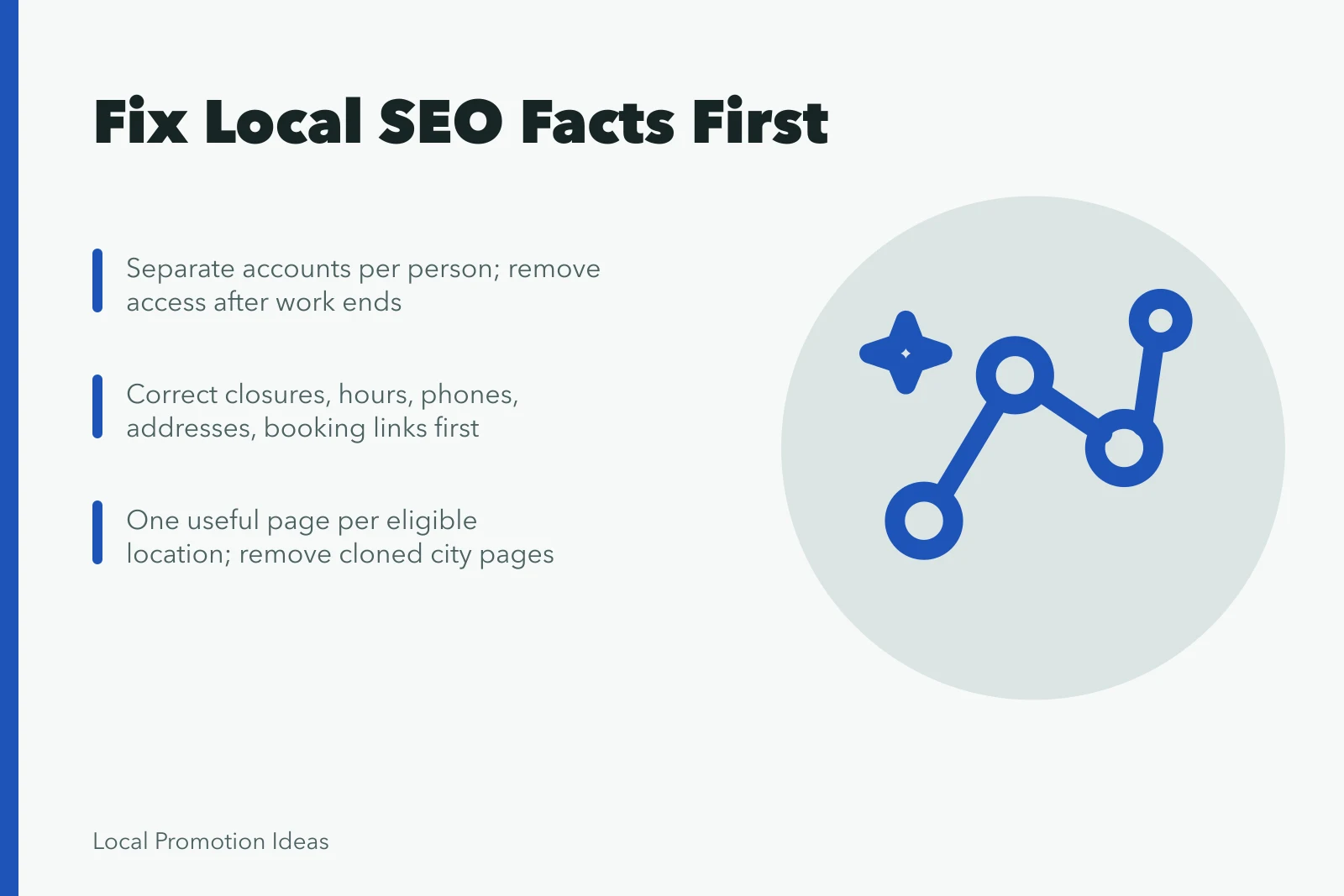
- Decide who owns the profile and who edits it before anyone touches customer-facing facts.
- Fix facts that send a customer to the wrong place, hour, phone or booking path first.
- Run one location and one customer path for 90 days, with a written baseline you can compare against.
- Judge the work on calls, bookings and sales, not on a single rank position.
- Scale to other locations only after permissions and the operating routine hold steady.
Owner and manager are different jobs
Google's profile roles are not a formality. An owner can add or remove users and delete the profile. A manager can edit most of what customers see but cannot perform ownership actions.
Owner vs Manager Roles
Owner
- Add/remove users
- Yes
- Delete profile
- Yes
- Edit customer-facing info
- Yes
- Daily work access
- Full
Manager
- Add/remove users
- No
- Delete profile
- No
- Edit customer-facing info
- Yes
- Daily work access
- Limited
That split decides who gets which login. The owner role belongs to an account the business controls, not to an agency, a former employee or a shared inbox. Managers get what the daily work needs and nothing more.
Write the mapping down: name, role, what they may change, when access ends. Remove access the week a contract or job ends, not the month after.
Fix hours, phone, address and booking link first
Fix These Facts First
- Regular and holiday hours
- Temporary closures
- Phone number
- Address or service area
- Booking link
- Services offered
- Accessibility, parking, payment methods
Keep one source-of-truth record and push it out to Google Business Profile, Bing Places, Apple Business Connect, industry directories and your own site. When the record and a directory disagree, the record wins and the directory gets corrected.
The record can be a single sheet or a shared doc. Fields: legal name, trading name, street address, suite, city, state, ZIP, phone, booking URL, hours per day, holiday hours, service list, service area, and last confirmed date.
It lives in the business's own drive, not in a vendor portal. One named editor owns it, with a review date.
One page per location, not twenty city pages
A location page earns its place when it carries something only that location can say. That includes a few key details:
One page per location
- address or service model
- phone
- hours
- directions
- parking
- the services done there
- the people who do them
Cloned city pages with the town name swapped say nothing a customer cannot already guess. Delete them rather than rewrite them.
Then test the path a customer actually takes. Here are the essentials to check on your mobile site:
One page per location
- Mobile reading
- HTTPS
- Indexability
- Title tags
- The call button
- The form
- Booking and ordering
A page that ranks and cannot take a booking is a dead end.
Categories and content that match real questions
Pick the most specific primary category that is true. Add secondary categories only where the business genuinely does that work.
Build the service copy from questions customers already ask: on calls, in site search, in sales conversations, in the profile's own search terms. Answer them in the order a buyer asks them, with pricing context where you can give it honestly.
Structured data should describe what is visible on the page. Marking up facts a visitor cannot see is a mismatch, not a shortcut.
Reviews and local mentions
Ask eligible customers after a real experience, in neutral words, and never script the rating. Reply to reviews without repeating personal details.
Mentions earned through suppliers, trade associations, sponsorships, events and community work carry more weight than a hundred directory listings nobody reads. Paid link schemes, invented awards and keyword-stuffed citations are the failure cases that undo the rest.
Measure the path, not one rank
Search Console's Performance report shows branded and non-branded queries, pages with impressions but few clicks, and position trends over time. Google's own guidance leans toward impression and click trends rather than position alone. The report covers links in Search, so it will not show every map view or profile action.
Pair it with the numbers your business already keeps. Profile interactions, calls, direction requests, and bookings. Also track qualified inquiries, closed sales, and whether the work fit your capacity that month.
A 90-day pilot for one location
Pick one location and one high-value customer path, such as emergency callouts or booked consultations. Record the baseline before you change anything: the current facts, the current page, the current monthly call and booking counts.
Typical setup runs 8 to 12 hours in the first month and 1 to 2 hours a month after that. A typical baseline for a single-location service business runs 40 to 120 calls and 10 to 40 bookings a month.
Log every edit with a date. At day 90, compare against the baseline in the systems that hold the money, not in a rank tracker.
| Stage | First evidence | Pass condition |
|---|---|---|
| Control | Owners, roles, recovery, suppliers | Business can recover the profile |
| Accuracy | Hours, phone, address, links, services | Live facts match the record |
| Relevance | Customer questions, pages, categories | The offer is clear to a stranger |
| Outcome | Calls, bookings, sales, capacity | Useful demand improves |
Questions to ask before buying tools
The GOV.UK technology selection guidance sets out adaptable choices, data control, security review and total ownership cost. Those four questions work well on any local SEO platform or agency retainer, and they are not product endorsements.
The CISA software acquisition fact sheet covers supply-chain exposure, deployment and vulnerability management. Ask the same of any vendor that will hold your listings, your analytics or your customer data.
For a local SEO platform, those four questions turn into four checks. Can I export every location and field? Who holds the admin account? What security review did the vendor pass? What is the total cost after year one?
Before any of this changes what customers see, it should sit inside a wider small business marketing strategy so the profile work and the paid work are not pulling apart.
Common questions
What should be fixed first?
Unauthorized access and any fact that can send a customer to the wrong place, time, phone or booking path. New content can wait until those are correct.
Should a business target every nearby city?
No. Build a geographic page only where the business can offer distinct availability, process, proof and constraints for that area. Otherwise the page repeats what the main location page already says.
How should rank tracking be used?
As a diagnostic sample. Record the geography, device, time, query and method, then judge progress on qualified inquiries and sales rather than the position number alone.
When is it safe to scale to more locations?
When the first location has a stable access list, a corrected fact record and a repeatable monthly check. Scaling before that copies the same errors across every profile.