Operations
Part of Getting Local SEO for Small Businesses Right the First Time
Which Local SEO Questions Come Up for Small Businesses
Local SEO questions for small businesses cover profile eligibility, names, citations, reviews, websites, rankings, account ownership, and agency control.
What to take away
- Confirm profile eligibility and real-world identity before changing names, categories, addresses, or service areas.
- No universal review count, citation format, or rank target can replace customer accuracy and business outcomes.
- Keep profile ownership and recovery with the business, even when an agency handles daily work.
Local SEO questions for small businesses usually concern profiles and rankings, but eligibility, ownership, website quality, customer accuracy, and reputation come first. These answers clarify the operating choices an owner should verify before paying for optimization.
Does every business qualify for a local profile?
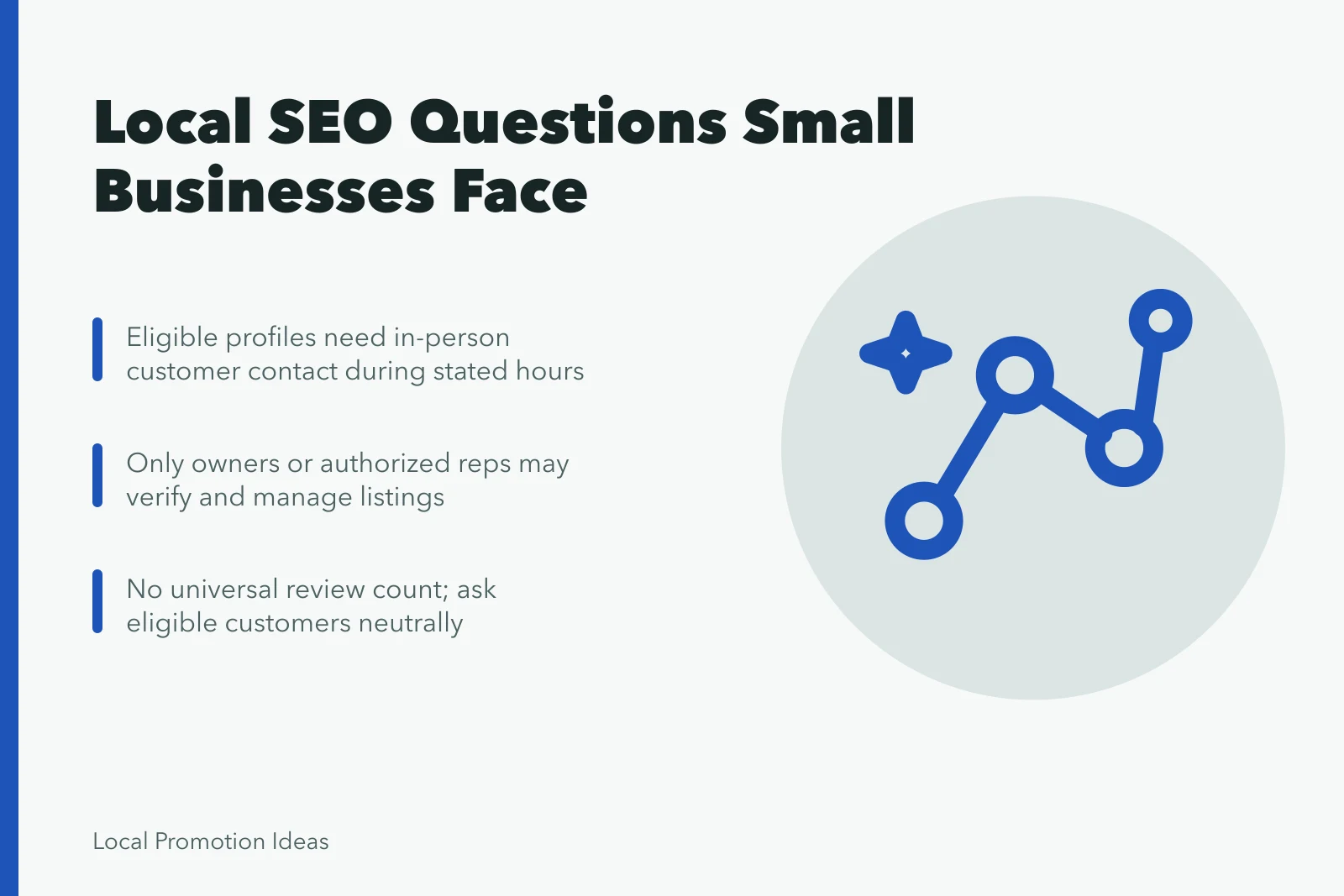
The Google Business Profile eligibility guidelines say an eligible Business Profile generally requires in-person customer contact during stated hours and list exceptions and ineligible models. It also says only owners or authorized representatives may verify and manage information. Apply the current platform rule to the actual business model rather than copying a competitor's listing.
Does the business qualify?
Does the business model fit platform rules?
Create and verify the profile
Decline and document why
No. Eligibility depends on the platform and business model. Document whether customers visit a staffed location, the business travels to customers, or a separately staffed department or practitioner exists. For example, a mobile pet groomer that travels to clients does not qualify, but a groomer with a staffed salon does.
Should service areas be added to the business name?
Only if the geography is genuinely part of the public real-world name. The Google Business Profile guidelines say to use the name represented consistently offline and place service area, category, hours, and address in their proper fields. For example, Joe's Pizza is fine, but Joe's Pizza Downtown is not unless that is the real-world name.
Do citations need identical formatting?
Customers and systems need consistent identity, but platforms may format suites, abbreviations, phones, or addresses differently. Maintain one approved source-of-truth record, fix wrong core facts and duplicates, and document legitimate variations. Prioritize maps, industry sources, licensing bodies, and directories customers actually use.
For example, a source-of-truth record could list 123 Main St, Suite 200 while a directory uses 123 Main St Ste 200. Correct any wrong street number or phone, because those confuse customers.
How many reviews are enough?
A typical range for a small local business is 20 to 50 reviews in the first year, then 2 to 4 new reviews per month. Review recency, themes, response quality, competitor context, and real customer experience alongside volume and rating.
Ask eligible customers neutrally and never buy, fabricate, gate, suppress, or condition incentives on positive sentiment. Applicable review rules vary by jurisdiction.
Is a website still necessary?
A website gives the business an owned place to explain services, locations, process, proof, policies, accessibility, and next steps. It also supports organic results and verification. A profile can capture direct actions, but its features and access can change. Keep both accurate and connected.
For example, a restaurant can list its menu, hours, and reservation link on its own site and link that site from its Google Business Profile.
Can an agency guarantee map rankings?
The Google local ranking help page says local results are mainly based on relevance, distance, and prominence and that a business cannot request or pay for a better local ranking. It recommends verified, complete, accurate information, current hours, reviews, and media. Treat those as product guidance, not a promise that completing fields produces a specified position.
Ranking promise vs reality
Agency promise
- Control
- Guaranteed position
- Factors
- Agency methods
- Evidence
- Fixed rank promise
Google guidance
- Control
- Cannot be bought
- Factors
- Relevance, distance, prominence
- Evidence
- Work, ownership, outcomes
No credible agency can control distance, every searcher's context, competitors, or platform algorithms. Google says local results are mainly based on relevance, distance, and prominence and cannot be bought. Require work, evidence, ownership, risk, and business-outcome commitments rather than a fixed position promise.
Typical agency retainers for local SEO range from $500 to $2,000 per month for a small business, depending on scope and market size. Ask for a written scope that separates one-time fixes from ongoing work.
Begin with an eligibility and ownership audit. Then correct customer-harming facts, the main location page, categories, hours, phone, service area, and conversion actions. Measure qualified contacts and sales alongside profile and website visibility.
Resolve the question with a decision record
| Question | Evidence to check | Safe decision |
|---|---|---|
| Is the profile eligible? | Contact model, staffed place, signage, rule | Create or decline |
| Who controls access? | Primary owner, roles, recovery, change log | Retain business control |
| Is visibility useful? | Qualified actions, sales, fit, capacity | Improve or stop |
The GAO evaluation design guide connects evaluation questions with evidence needs and design choices. Evaluation questions also decide which small business content marketing pieces earn a place in your plan.
The W3C Privacy Principles statement gives web-system designers shared privacy concepts and warns against shifting privacy work to individuals.
Common questions
Does a service-area business need a public address?
Not always. Follow the selected platform's current rules and publish only an address where customers are genuinely served and disclosure is permitted. For example, a mobile plumber can list a service area without a street address if the business meets the Google Business Profile eligibility guidelines and does not receive customers at a home office.
Should every directory use identical formatting?
Maintain the same underlying facts, but allow legitimate field, country, abbreviation, and platform differences. Correct errors that confuse customers or misidentify the business. For example, use Suite 200 on the master record and allow Ste 200 or # on platforms that require it, but never change the street number or phone.
Who should own the main profile?
The business should retain primary ownership, recovery, and records, then give employees or suppliers the minimum role required for their work. For example, the owner keeps the primary login and recovery email, and gives a marketing agency manager access with a written change log.