Rules
3 points on reading newsletter benchmarks
Reading newsletter benchmarks means tracking open, click, and conversion rates against CAN-SPAM rules that set the floor for every commercial send.
What to take away
- CAN-SPAM applies to every commercial send, including the ones a vendor sends for you, so your benchmark for "compliant" starts there.
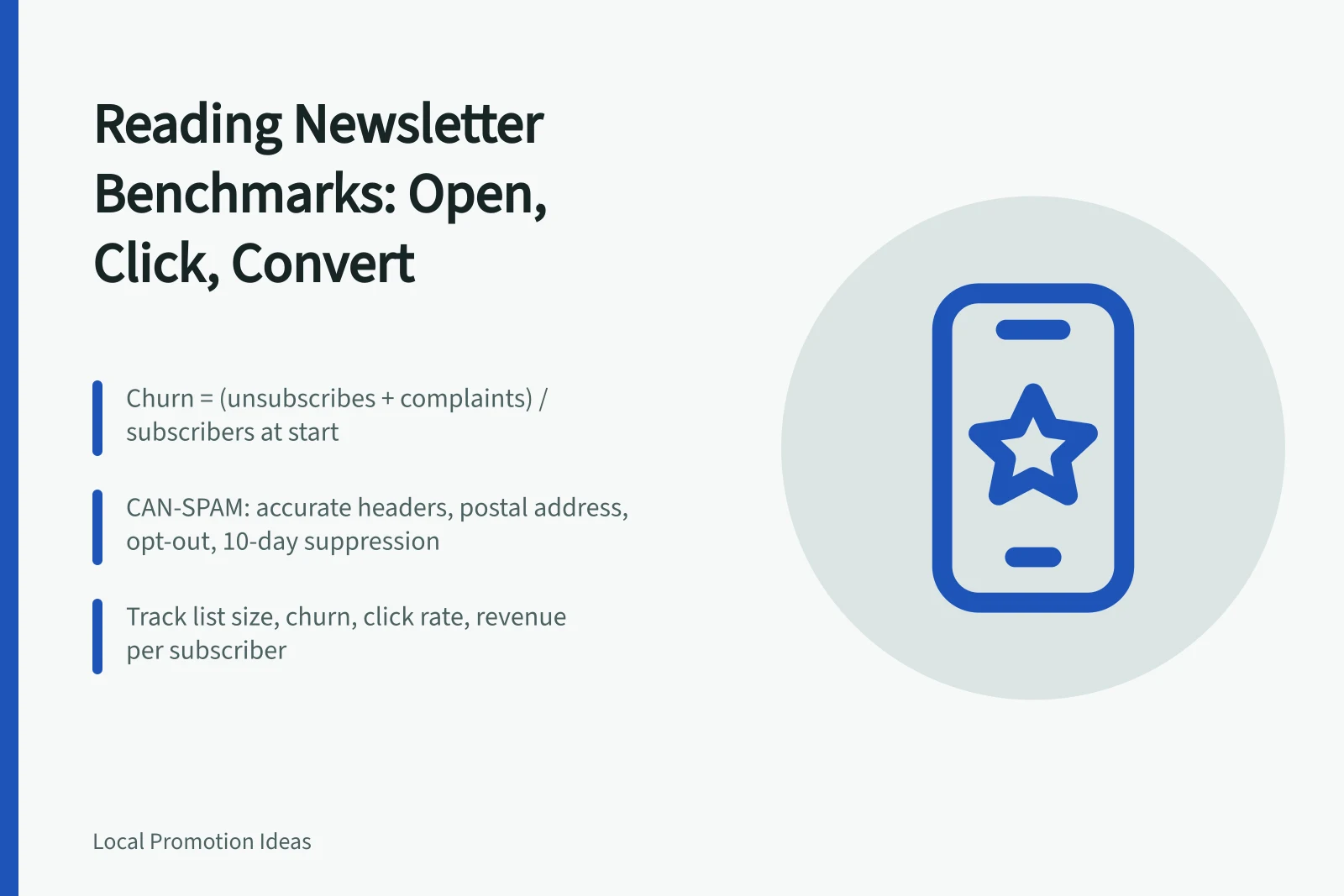
- The FTC requires accurate header information and subject lines, a postal address, a working opt-out, and suppression within ten business days.
- Negative-option offers need the material terms disclosed before billing information is collected, and consent before the first charge.
- The IRS lets you pick your own recordkeeping system as long as it clearly shows income and expenses and supports purchases, sales, payroll and assets.
- Benchmark the unsubscribe rate against your own past sends, not against a published industry number you cannot verify.
A newsletter list is a compliance asset before it is a marketing one. Every metric you pull from it, open rate, click rate, churn, sits on top of a legal floor you have to clear first. This is not legal advice; confirm your own obligations with a licensed attorney.
What CAN-SPAM actually requires
The FTC's CAN-SPAM Act compliance guide covers commercial email sent by a business, and it applies whether you send it yourself or a vendor sends it on your behalf. The vendor rule is the one owners miss. If you hire an agency or a platform to run your sends, the responsibility stays with you.
CAN-SPAM compliance checklist
- From, to, reply-to identify sender accurately
- Subject line reflects the message
- Valid physical postal address included
- Opt-out works without fee or login
- Stop sending within ten business days
Once someone opts out, you have ten business days to stop sending. That window is the reason suppression lists belong in your process, not in someone's memory. A subscriber who unsubscribes and still gets the next issue is the failure case that turns into a complaint.
When the offer is a trial
Free trials and discounted first months are negative-option offers, and the FTC has said plainly that a "risk-free" trial that bills without clear disclosure is not risk-free. Its ROSCA recap lays out what the offer has to do before it takes a card.
Trial offer compliance steps
- Disclose material terms before collecting billing info
- Get express informed consent before first charge
- Give a simple way to stop recurring charge
- Check state law duties with an attorney
Pick the numbers that change a decision
Run the arithmetic in your own variables. Let S be subscribers at the start of the period, U the unsubscribes, C the spam complaints, and A the new signups.
Newsletter metrics to track
- List sizesubscribers at start
- Churn rate(U + C) / S
- Click ratemain link clicks
- Revenue per subscribereconomic value
Your churn rate is (U + C) / S, and your net growth is (A - U - C) / S.
Neither number means anything without a comparison window, so keep the period fixed month to month.
Track four things and stop. List size, churn rate, click rate on the main link, and revenue per subscriber. A high list count is not proof of economic value; a list of 20,000 that never clicks is worth less than 2,000 that do. If a metric has never changed a decision, retire it.
The guide to reading newsletter audience analytics covers how to set those windows so a new send is not compared against a mature back catalog.
Records that back the numbers
The IRS recordkeeping guidance says you can choose any system that clearly shows your income and expenses, as long as it supports purchases, sales, payroll, assets and other transactions. For a newsletter business that means sponsor invoices, platform fee statements, contractor payments and the 1099-NEC forms you file for anyone paid $600 or more.
Keep the consent record too. The timestamp and source of every opt-in is what you produce if a subscriber complains. If you cannot show when someone signed up and from where, you cannot show they agreed.
Worked example: a sponsor slot priced on the wrong number
Say you sell a sponsor slot at a flat rate R per send and your list is S subscribers. Cost per thousand impressions is R / (S / 1000).
If R is $400 and S is 4,000, that is $100 CPM, which is high for a small list and will not survive a second sponsor asking for the same terms.
Now price it against clicks instead. If the click rate is c and the sponsor pays P per click, your revenue is P * c * S.
At a 2% click rate and $2 per click on 4,000 subscribers, that is $160, well under the flat rate. The flat rate only holds if you can show the sponsor a conversion number, and that is a conversation about their data, not yours.
Common questions
Does CAN-SPAM apply if a vendor sends the email for me?
Yes. The FTC guide states that the business on whose behalf the message is sent is responsible, and vendors that send on your behalf can also be liable. Put the compliance terms in the vendor contract and check suppression handling before the first send.
How fast do I have to honor an unsubscribe?
Ten business days under CAN-SPAM. Build the suppression list into the send process so the next issue cannot go to someone who already opted out.
Can I benchmark my churn rate against published industry numbers?
Only if you can verify the source and the list it came from. Most published newsletter benchmarks do not disclose their methodology, so use your own prior periods as the comparison and treat outside numbers as directional at best.
What records should I keep for a newsletter business?
Whatever system clearly shows income and expenses, plus the documents behind them: sponsor invoices, platform statements, contractor payments and opt-in records. The IRS recordkeeping page lists the categories; your CPA can tell you how long to hold each one.