Careers
Growing a bakery through marketing that actually earns trust
The practical question behind 'bakery marketing guide' is how the decision will work during an ordinary operating day. This guide treats the topic as a series of.
What to take away
- Complete every Google Business Profile field, then post a photo or update each week.
- Ask all customers for a review after a completed order, with no incentives and no filtering.
- Track inquiry source, quote-to-order rate, average order value and repeat rate at 60 days.
- Sign two or three written partnerships before spending money on ads.
- Cap every promotion at what the oven and the crew can actually produce.
Fix the free local foundation first
A stranger asks four things: are you open, what do you sell, how do I order, and when can I collect it. Answer those on the listing and the site before buying any advertising.
Google ranks local results on relevance, distance and prominence, so complete information and fresh photos carry more weight than a small ad budget. If the shop or its location is still undecided, the site selection guide explains what actually protects foot traffic before you market anything.
Define the bakery's local position
- Occasions, products, price level, service model
- Location, lead times, customer groups
- Test during ordinary week and under pressure
- One person maintains process; exceptions visible
- Use qualified inquiries and repeat sales
| Weekly task | Time | What to watch |
|---|---|---|
| Profile post and two photos | 20 minutes | Calls and direction requests |
| Review asks on completed orders | 5 minutes | New reviews, recurring themes |
| Partner check-in | 30 minutes | Repeat wholesale orders |
| Message to past customers | 20 minutes | Repeat orders within 60 days |
Example: listing fields that do the work
Use the name on the sign. Set Bakery as the primary category, then the closest secondary ones. Add service options, holiday hours, an ordering link, a menu link and 15 to 20 current photos.
A workable description reads like this:
Neighborhood bakery in Dayton. Sourdough, croissants and custom cakes. Order online for pickup. Custom cakes need 72 hours.
Plain sentences, real products, real lead time. That is the model to copy.
Ask for reviews with one honest script
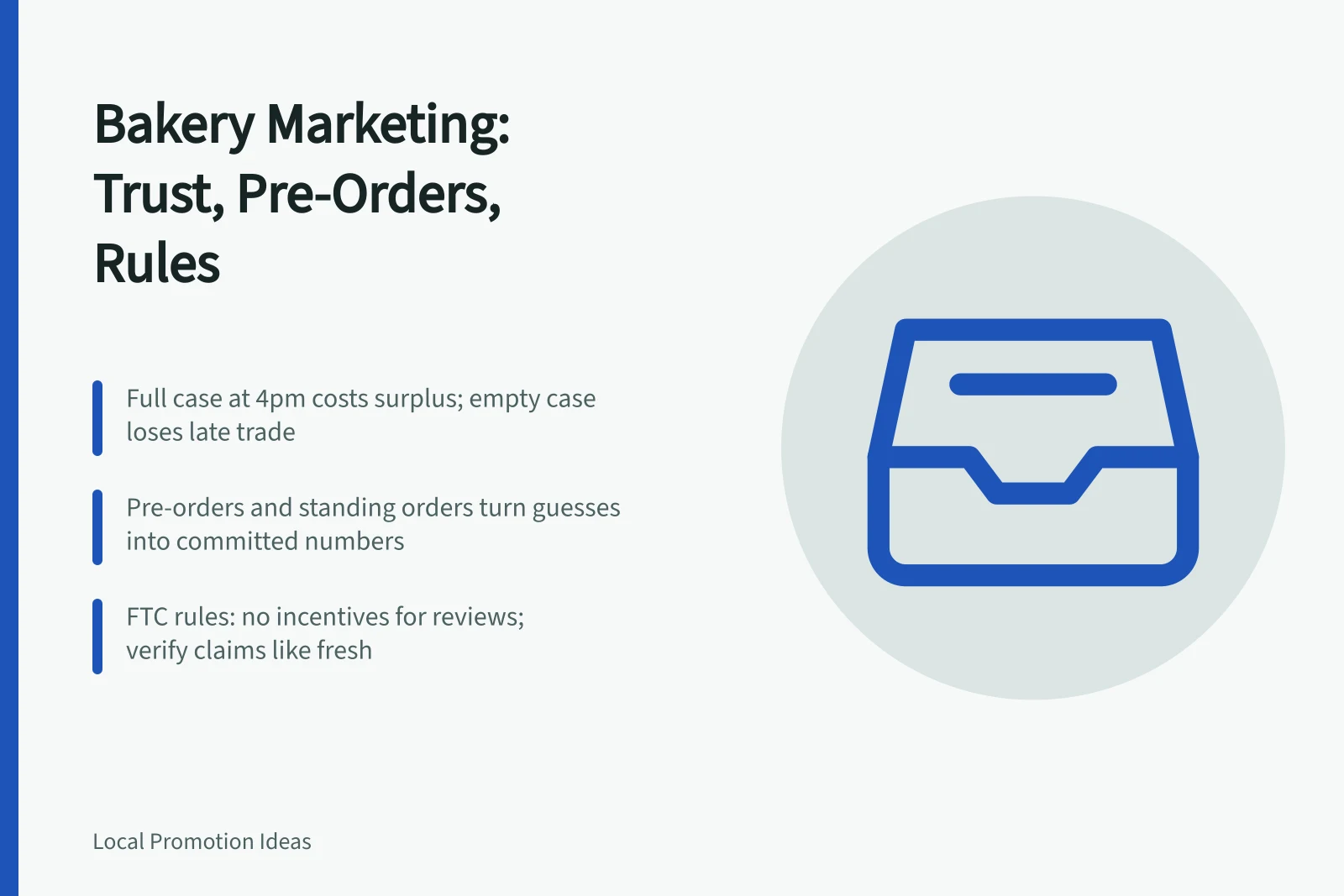
Ask after the order is handed over, not before. Never skip people you expect to complain, and never offer a discount, free item or prize for a review. The FTC guide to soliciting and paying for online reviews treats selective asking and incentives as deceptive.
Thanks for picking up your order. If you have a minute, a Google review helps neighbors find us. Here is the link. If something was wrong, reply here and we will fix it.
Reply to every review within a few days. Address the point raised, keep order details and health information out of the reply, and move the discussion to a direct message. Claims such as "best in the city" need evidence, and the FTC advertising FAQ covers substantiation and disclosure.
Build partnerships with a written offer
Choose partners whose customers need what you bake and who do not compete: coffee shops, wedding venues, planners, caterers, offices, schools, hotels and farmers markets. Write one page.
- Who you are and where you bake.
- What you deliverproducts, quantities, delivery days, wholesale price.
- What you needa weekly order by a set time, a display spot, a named contact.
- A four-week trial with a review date and either side free to stop.
A standing office order of mixed pastry boxes is easier to hold than one-off catering, and bundling products into packages shows how to price that box so it stays worth making. Say so when money changes hands; a paid post that reads like a customer rave breaks endorsement rules.
Track orders with four numbers
- Quote-to-order rate = orders divided by qualified quotes, times 100.
- Marketing cost per order = spend for that source divided by orders from that source.
- Average order value = revenue divided by orders.
- Repeat rate = customers ordering twice in 60 days divided by customers in the period.
Ask every caller and walk-in how they heard about you, and record it at the counter. Clicks do not pay rent. Wholesale and preorder mixes change the margin math, so the pricing guide shows how to protect margin on both.
Test one change in four weeks
- Week 1record starting numbers and pick one change, such as a review ask at the counter.
- Week 2run it on every order and note what staff say about it.
- Week 3fix the wording and retrain whoever runs it.
- Week 4compare with week 1, then keep, change or drop it.
Thirty-day bakery marketing rollout
- Week 1Document process, owners, data, compliance, failure point
- Week 2Test one measurable change; collect worker comments
- Week 3Correct workflow, update standard, train roles, confirm records
- Week 4Compare results, record risks, set review, decide expand/revise/stop
Match promotions to production capacity
Promote only what the oven, bench, cooler and crew can carry. If a weekend special sells 40 extra loaves, someone still mixes, shapes, bakes and bags them that morning. Cap the offer, or take preorders with a cutoff and hold that number.
Check ingredient costs before locking a promotional price; the USDA food price outlook tracks monthly movement across flour, eggs and dairy. Training gaps surface as broken promises, so the hiring and training plan sets the staffing that makes the calendar real.