Operations
The habits behind hotel marketing that actually book rooms
hotel marketing best practices keep room and price facts accurate, make images and booking accessible, align channels with demand, protect trust, and verify stays.
What to take away
- Describe the exact room and stay a traveler can book.
- Use image alternatives that match each image's function and context.
- Disclose commercial content clearly and inspect the complete impression.
Hotel marketing best practices reduce uncertainty while protecting the hotel's ability to deliver. Show current proof, make the full choice understandable, provide a usable path, and measure what happened after the reservation.
Make images informative and accessible
W3C's alt text decision tree distinguishes informative, functional, text-bearing, redundant, and decorative images. Use the image's purpose in the actual page to choose appropriate text, and place complex information in accessible page content.
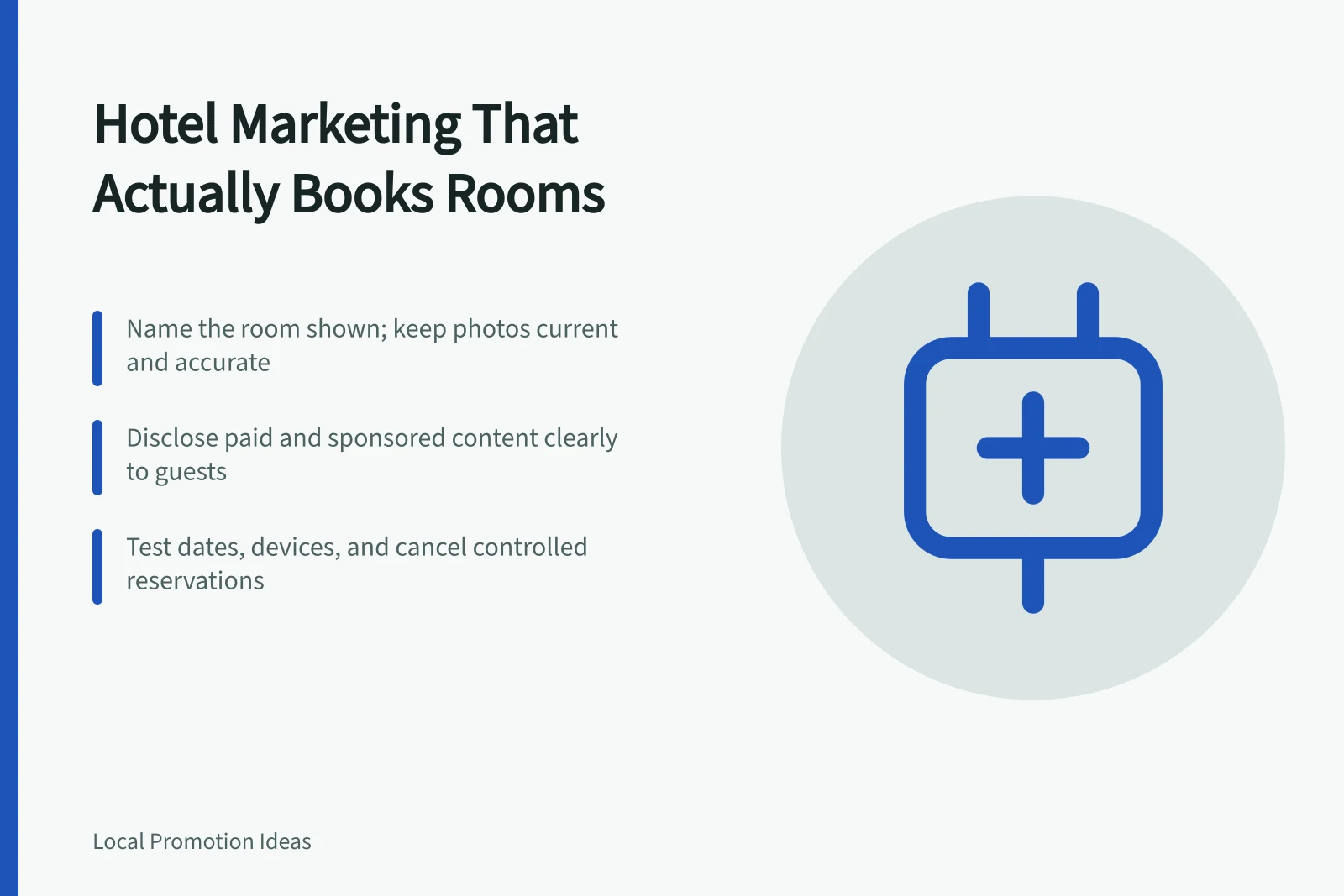
Name the room or facility shown and keep the photo current. Do not imply a view, size, setup, accessibility feature, or included service the bookable product lacks.
Provide captions or nearby text when travelers need more detail. Incomplete room facts are one of the most common hotel marketing mistakes, so captions and alt text must match the bookable product exactly.
Label paid and sponsored material
The FTC's native advertising guide for businesses explains that the overall context matters and that commercial content should not mislead people about its nature or source. Apply current rules to the actual format, audience, sponsor, creator, and placement.
Practice / Operating proof
- Accurate rooms
- Field owner, date, bookable mapping, correction log
- Complete price
- Itinerary test through final payment
- Useful channel
- Role, incremental demand, full cost, dependency
- Usable booking
- Device and access tests with failure recovery
- Service alignment
- Staff brief, delivery standard, exception route
- Real measurement
- Completed stay and finance reconciliation
Review live output
- Search the property as a guest in relevant markets
- Test dates with availability and sold-out dates
- Compare paid, free, partner, map, and direct displays
- Open every destination on representative devices
- Complete and cancel controlled reservations
- Verify the corrected public result after changes
Keep a weekly exception list. It should show inaccurate content, feed failures, unavailable rates, booking errors, unanswered questions, service capacity concerns, guest complaints, access problems, measurement gaps, and overdue corrections. Fund work that closes material exceptions before adding low-value activity.
Also sample successful journeys. They reveal which room proof, staff handoff, and booking details should be protected when teams redesign pages or replace systems.
Assign the practice
The NIST Privacy Framework starting guide outlines a voluntary process for identifying and managing privacy risk. Use it to assign data and response owners for hotel marketing best practices; it is not legal clearance.
The CISA business-system logging guidance explains how event records support security review. Preserve appropriate hotel marketing best practices access, change, failure, and correction records without claiming that logging validates a metric.
Turn each practice into an owner, cadence, input, output, acceptance test, and correction path. Observe the work during a normal reporting cycle and during one controlled failure. Keep the result with the metric definition and decision record. A written policy has little value when access changes, source defects, and disputed conclusions leave no trace that another reviewer can follow.
For hotel marketing best practices, keep the evidence record beside the decision so a reviewer can reproduce the reasoning without memory. Set the next review date and name the change that triggers an earlier check.
Record rejected options and the chosen path because the original constraint may later change. Use the same definitions in the interface, export, meeting note, and correction log, and close unused reports and permissions after the decision cycle ends.
Common questions
How often should hotel content be checked?
High-change facts may need automated or daily review; stable pages still need scheduled and event-driven checks.
Are lifestyle images enough?
No. Travelers also need accurate, current room, facility, location, price, policy, and access evidence.
What is the strongest best practice?
Give every material public fact and guest promise an authoritative source, owner, distribution map, and correction route.