Reviews
Part of Small Business Social Media: A 90-Day Operating Reset
Operating Principles for Small Business Social Media
Small business social media best practices here are operating principles for posts, account control, disclosures, accessibility, replies, and measurement.
What to take away
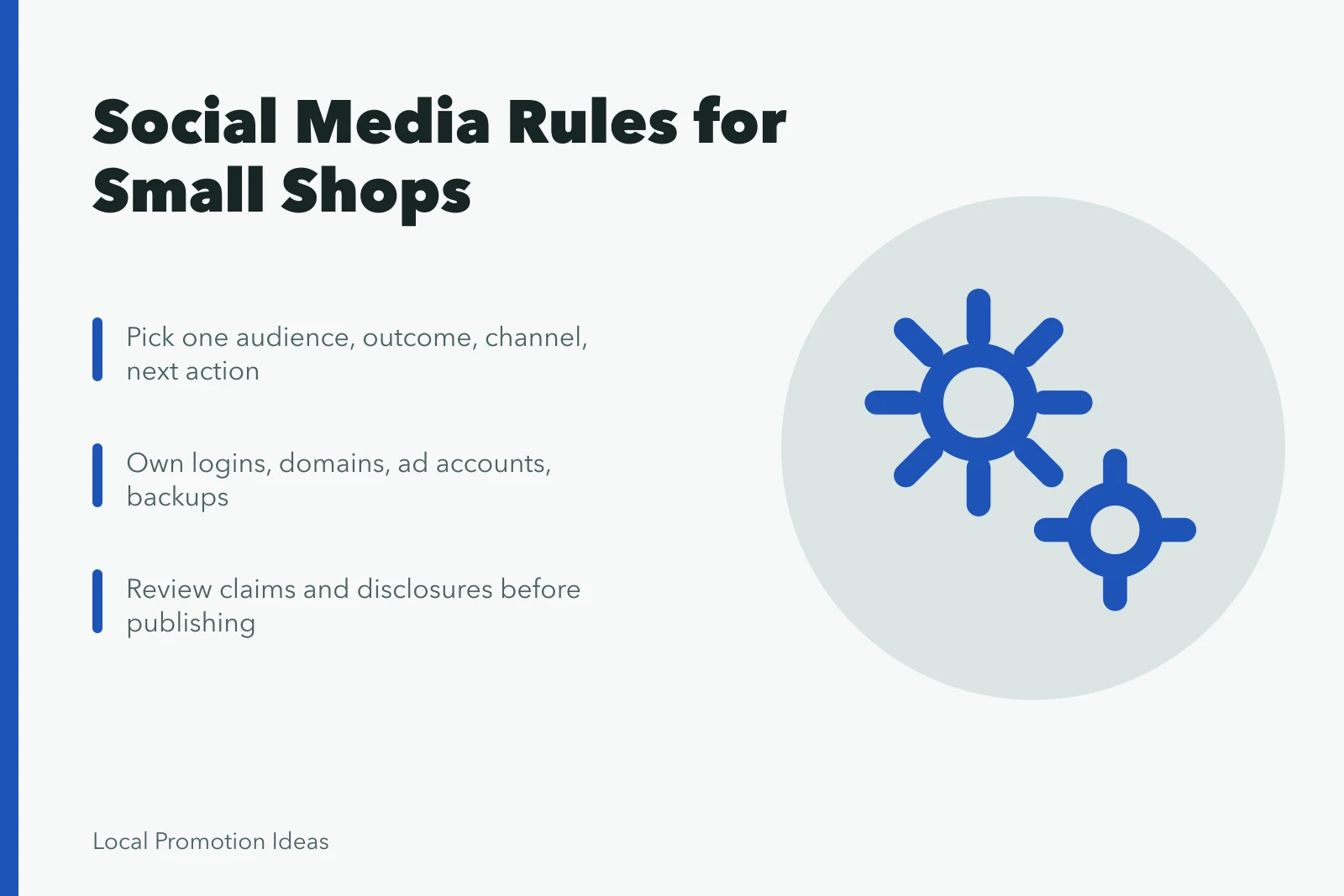
- Focus each planning cycle on one audience, outcome, primary channel, and useful next action before expanding.
- Make claims, commercial relationships, media rights, accessibility, and customer responses reviewable before publication.
- Use platform data to make decisions, then connect it with customer, financial, service, and capacity evidence.
Small business social media should make useful communication repeatable and safe. These are operating principles, not guarantees of reach. For a local business, tie each post to a specific service area, store, event, offer, or customer question, and make the next action clear. Adapt the practices to the platform, audience, resources, jurisdiction, and risk of the business, using business social media guidance when needed.
Focus before expanding
Choose a primary audience, outcome, channel, and next action for each planning cycle. Add another channel only when customer behavior and team capacity support the extra production, moderation, access, and measurement work.
Put local promotions on the right platform
Choose channels based on where local customers look for updates, then match the post format to the message. Keep business hours, service area, offer terms, availability, and the destination page current so a promotion does not send customers to outdated information.
- Facebook:Keep the Page’s address and hours current. Use Events for workshops and community promotions, and posts for offers with clear terms and an expiration.
- Instagram:Use Reels for demonstrations, Stories for timely updates, and carousel posts to explain service options. Tag the location and use relevant neighborhood hashtags without stuffing them into every post.
- TikTok:Make short vertical videos that demonstrate a product or service and identify the local context. Use audio only when the business has the necessary rights.
- X:Share timely service changes and event reminders. Monitor mentions and replies, and use only relevant local hashtags.
- LinkedIn:Share local business expertise, project examples, hiring news, or partner updates. Make the service area and intended business audience explicit.
- YouTube:Publish searchable how-to videos or Shorts that demonstrate a product or service. Include the service area in the title or description, add accurate captions, and point viewers to a relevant booking or service page.
- Pinterest:Create evergreen Pins for seasonal projects or visual planning, with searchable descriptions and a link to the relevant local offer or service page.
Set a sustainable publishing and response rhythm
Choose a posting cadence the team can maintain rather than copying another business’s volume. Set a response-time target that reflects staffed hours, tell customers when to expect service, and route urgent safety, payment, or account issues promptly. Monitor comments, inboxes, tagged posts, mentions, and searches for the business and neighborhood; use repeated questions to shape future content.
Native analytics can help compare results across channels. For scheduling and reporting, consider Meta Business Suite, Buffer, Hootsuite, or Later; before subscribing, check current channel support, permissions, approval controls, reporting, and price.
Keep business control
Own recovery, billing, domains, Pages, profiles, ad accounts, archives, and connected assets. Use strong authentication, named people, minimum permissions, backup administrators, regular access reviews, and prompt offboarding. Never let a vendor hold the only login.
Business Account Control Checklist
- Own recovery, billing, domains, Pages, profiles
- Use strong authentication and named people
- Set minimum permissions and backup admins
- Review access regularly and offboard promptly
- Never let a vendor hold the only login
Build from customer evidence
Turn real questions, objections, tasks, comparisons, and support problems into demonstrations and decision help. Protect confidential details. Use the customer's language while maintaining technical accuracy, brand standards, and a clear path to fulfillment.
Make every claim reviewable
The FTC's native advertising guide for businesses explains that promotional content can be deceptive when consumers are misled about its commercial nature. It says necessary disclosures must be clear and prominent and evaluated in the context of the whole presentation. Review the message before the click as well as the destination and any later reuse.
Record the source, date, limitation, approval, and published version for objective claims. Do not let a testimonial or creator repeat a claim the business could not substantiate directly. Update or withdraw expired prices, availability, results, and guidance. Expired prices and unsupported claims are among the small business social media mistakes that surface when no one owns the account record.
Disclose relationships clearly
When a brand relationship may affect how an endorsement is evaluated, review the FTC's Guides Concerning the Use of Endorsements and Testimonials in Advertising and its .com Disclosures: How to Make Effective Disclosures in Digital Advertising. Put a clear, hard-to-miss disclosure with the endorsement; examples include “Ad” or “Sponsored” when accurate, and the message should explain a relevant payment, free product, or other material relationship. A platform’s paid-partnership label may supplement a clear disclosure. Review the specific relationship, presentation, audience, jurisdiction, and platform rule before publication, and place a plain disclosure where people can notice and understand it.
Design for access
For U.S. businesses, assess accessibility obligations that apply under the Americans with Disabilities Act (ADA); WCAG 2.2 offers a technical reference, though the applicable legal standard depends on context. W3C's visual-information description guidance explains when prerecorded video needs audio description or a descriptive transcript so essential visual information is available to people who cannot see it. It recommends planning description during production, which can reduce later work. Test the final media in context.
Provide accurate captions for spoken words and meaningful sounds, readable text, useful descriptions and links, adequate contrast, and alternatives to audio-only or color-only meaning. Test mobile crops and destinations. Include disabled users and qualified reviewers in research rather than treating accessibility as a final checkbox.
Treat replies as service
Set response ownership, timing, tone, privacy boundaries, and escalation. Acknowledge reasonable criticism, move personal cases to secure channels, preserve evidence during incidents, and route repeated confusion back to product, operations, or content owners.
Measure decisions
Compare like cohorts within each platform and reconcile native metrics with visits, inquiries, sales, returns, retention, and capacity. YouTube, LinkedIn, Pinterest, and other systems expose different measures, so define each calculation and annotation before reporting. A small business social media benchmarks review compares like content and defines each rate before anyone reports a number.
Review these practices quarterly and after any major access, agency, product, policy, or platform change. The most valuable improvement is usually the constraint that harms customers or prevents the team from learning.
Operating-principles test
| Practice | Evidence | Failure signal |
|---|---|---|
| Focus | Audience, outcome, channel, action | Unowned broad activity |
| Truth | Source, limits, disclosure, approval | Unsupported impression |
| Access | Captions, descriptions, contrast, tests | Customer exclusion |
| Learning | Defined platform and business data | Vanity-only report |
Assign the practice
The NIST Privacy Framework starting guide outlines a voluntary process for identifying and managing privacy risk. Use it to assign data and response owners for small business social media; it is not legal clearance.
The CISA business-system logging guidance explains how event records support security review. Preserve appropriate access, change, failure, and correction records for social media accounts without claiming that logging validates a metric.
Common questions
Which best practice should come first?
Restore business account control and correct any public promise or destination that can mislead, expose, or strand a customer.
Are best practices the same on every platform?
No. The operating principles transfer, but formats, permissions, disclosures, analytics, customer behavior, and platform rules require channel-specific execution.
How often should practices be reviewed?
Review them quarterly and after a major supplier, staff, account, campaign, product, legal, security, accessibility, or platform change.