Costs
Part of Small Business Social Media: A 90-Day Operating Reset
5 Things the Small Business Social Media Case Studies Teach
Small business social media case studies examine Audio in the Trees and Contour Cube, separating useful operating choices from self-reported results.
What to take away
Small business social media case studies can reveal operating choices. Case studies also show decisions and constraints, but they do not establish what a different business will achieve.
- Audio in the Trees connects scheduling with real-world community knowledge and a small distributed delivery model.
- Contour Cube used early content, limited product tests, customer feedback, and repeated operational learning before full maturity.
- Beardbrand built a YouTube channel of grooming tutorials around founder Eric Bandholz, then sold beard care products to that audience.
- Death Wish Coffee won the 2016 Intuit QuickBooks Super Bowl ad contest by rallying social media followers to vote.
- Dollar Shave Club launched with a 2012 video that cost about $4,500 and brought 12,000 orders in 48 hours.
The common lesson is operational fit: match content to community knowledge, a workable publishing system, customer feedback, or product learning, not the biggest number.
The review covers small business social media case studies from Buffer and other public sources. This unpaid, non-ranking review uses two vendor-published Buffer stories plus three public startup cases. Buffer sells the social media management product discussed, so treat the two Buffer results as self-reported. Other figures are attributed claims, not independent verification or endorsement.
Audio in the Trees: manage around the work
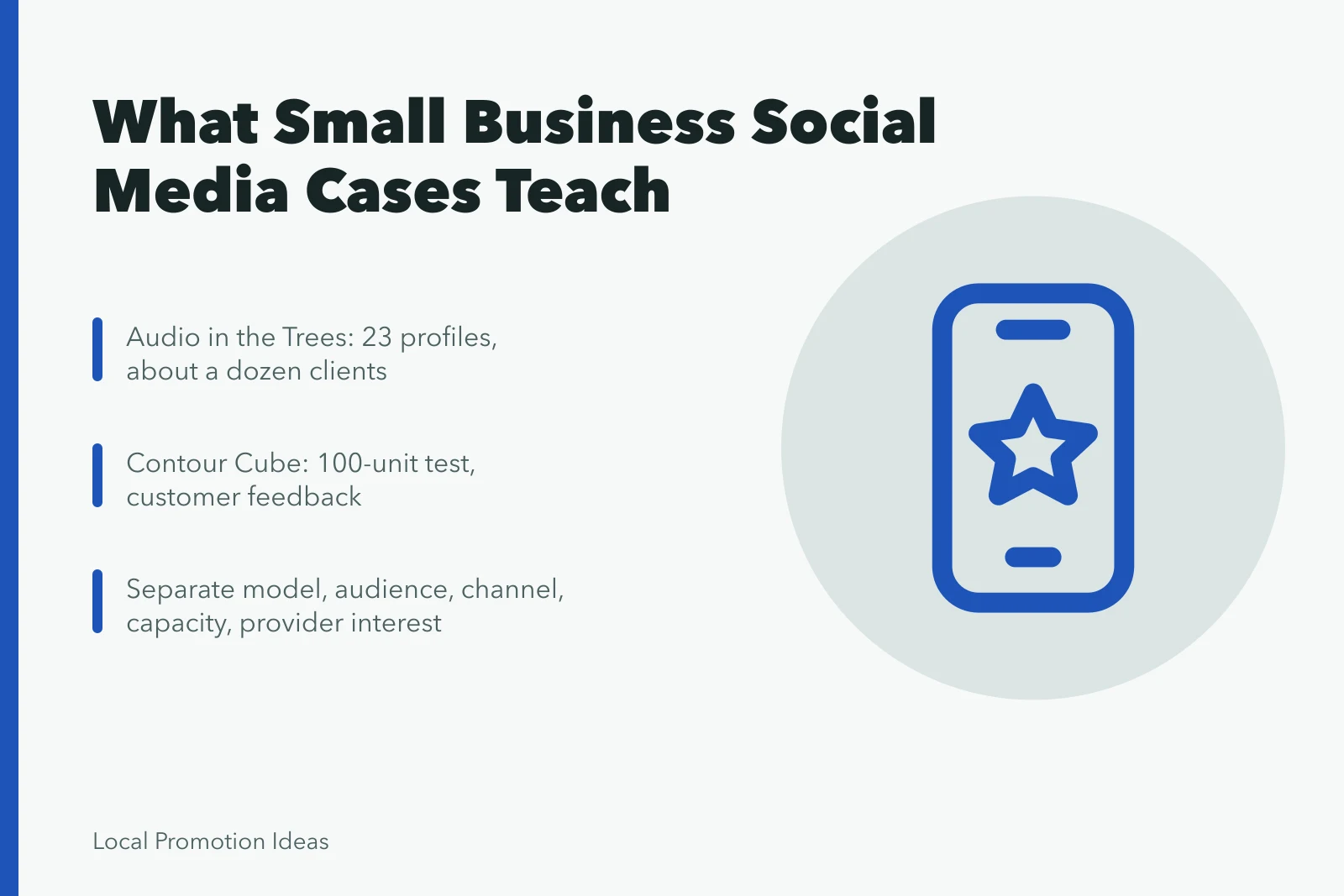
Buffer's Audio in the Trees case study attributes 23 managed profiles across about a dozen clients to the featured agency. It describes scheduling, staffing, reporting, and community practices. Verify any material claim directly with the agency and current account records.
A Buffer case study published in August 2026 profiles boutique agency Audio in the Trees. It manages 23 profiles for about a dozen clients, mostly music venues, bars, and restaurants.
The account stresses community knowledge, opportunistic real-world content, and a long-running scheduling workflow. The transferable lesson: design production around where useful moments occur, while keeping client approvals, rights, access, and incident responsibility.
Contour Cube: learn before perfecting
Buffer's Contour Cube founder story credits co-founder Sarah Forrai with prototype, audience, stock, sales, and growth figures. It describes early product videos, a 100-unit test, customer comments, restock communication, and product changes.
Check the pattern against a new business's demand, margins, inventory, rights, and risk. Vendor-published case study numbers need a baseline; small business social media benchmarks show how to compare rates and spot outliers.
A 2024 Buffer article by Contour Cube's founders describes using early TikTok content and a 100-unit product run to test interest before the product was fully mature. They report rapid sellouts, substantial audience growth, and seven-figure sales over two years.
The transferable practice is a bounded market test with transparent limitations, operational capacity, customer feedback, and no artificial or misleading scarcity.
How to use these cases
For each story, separate the business model, starting audience, channel, offer, and production capacity. Then list paid support, time period, and provider interest. Contact the featured business when material decisions depend on a claim. Test one principle with a small budget and defined guardrails rather than copying a format or headline.
The public evidence is the YouTube channel: grooming tutorials with founder Eric Bandholz and product links in descriptions. Beardbrand does not publish the click-through rate to product pages. The video-to-sale path is not verifiable from outside. The transferable choice is niche instruction. Test it by sustaining weekly tutorials that answer specific questions.
The 2016 Intuit QuickBooks Super Bowl ad contest gave the company a 30-second spot. The rules and voting period were public, and fans rallied to vote. Intuit paid for the ad, not Death Wish Coffee. The contest did not publish a sales baseline, so the ad's lift is not public.
The transferable choice is a public voting campaign. Test it only if the business already has a vocal fan base and can track new customers.
The 2012 launch video was posted to YouTube and reportedly cost about $4,500 to produce. The 12,000 orders in 48 hours figure comes from founder Michael Dubin's public accounts. The customer acquisition cost, repeat rate, and churn are not public.
The transferable choice is a simple offer in a short video. Test it by making one clear promise and measuring orders from a single landing page.
Case-study transfer test
Case-Study Transfer Test
Audio in the Trees
- Transferable choice
- Workflow around community work
- Evidence gap
- Vendor-selected account data
Contour Cube
- Transferable choice
- Bounded test and learning
- Evidence gap
- Self-reported growth results
New business
- Transferable choice
- One controlled principle
- Evidence gap
- Own baseline and economics
The table below applies the test: which choice transfers, and what evidence remains missing.
Transferable choice
- Audio in the Trees
- Workflow around community work
- Contour Cube
- Bounded test and customer learning
- Beardbrand
- Niche tutorial content on YouTube
- Death Wish Coffee
- Fan voting in a public contest
- Dollar Shave Club
- Simple launch video with a clear offer
- New business
- One controlled principle
Evidence gap
- Audio in the Trees
- Vendor-selected account data
- Contour Cube
- Reported growth results
- Beardbrand
- Founder-led channel data
- Death Wish Coffee
- Contest rules and baseline sales
- Dollar Shave Club
- Reported orders lack public cost detail
- New business
- Own baseline and economics
Audit the published evidence
The FTC advertising substantiation policy requires a reasonable basis before objective claims. Apply that rule to public small business social media case studies performance statements. For a case study, the business must hold records for any performance number it publishes.
The FTC guidance for marketers using reviews warns about fake feedback, selective requests, conditioned incentives, hidden relationships, and paid rankings. In a case study, check whether the business paid for the post, gave free product, or edited the timeline. A vendor case study that names a provider needs a disclosure line.
Common questions
Are these case studies independent?
No. Buffer's blog hosts both Buffer cases. The other three are company or founder posts. Check the byline, the publication date, and whether the article shares account screenshots.
Can another business expect the same results?
No. Start with your own baseline: current reach, conversion rate, and fulfillment capacity. Then change one variable for a set period. A case study from another market cannot supply your baseline.
What should be verified before copying a tactic?
Ask for the raw numbers behind any rate: impressions, clicks, orders, and refunds. Check who paid for the content and whether the business can share account screenshots. If the case study omits the denominator, treat the result as an anecdote.