Guides
Do accurate pins and real hours fix most roadside navigation apps errors?
What roadside businesses can do to appear correctly in navigation apps: accurate pins, real hours, useful categories and getting onto official trail listings.
What to take away
- Fix the pin first. A location dropped at the wrong end of a lot, or behind the building, loses customers silently.
- Hours are the field travelers act on, and stale hours do more damage than missing ones.
- Claim your listing in Google Maps, Apple Maps, Bing Places and Yelp, and correct the pin in Waze.
- Getting onto an official route or trail listing puts you on maps you cannot edit yourself.
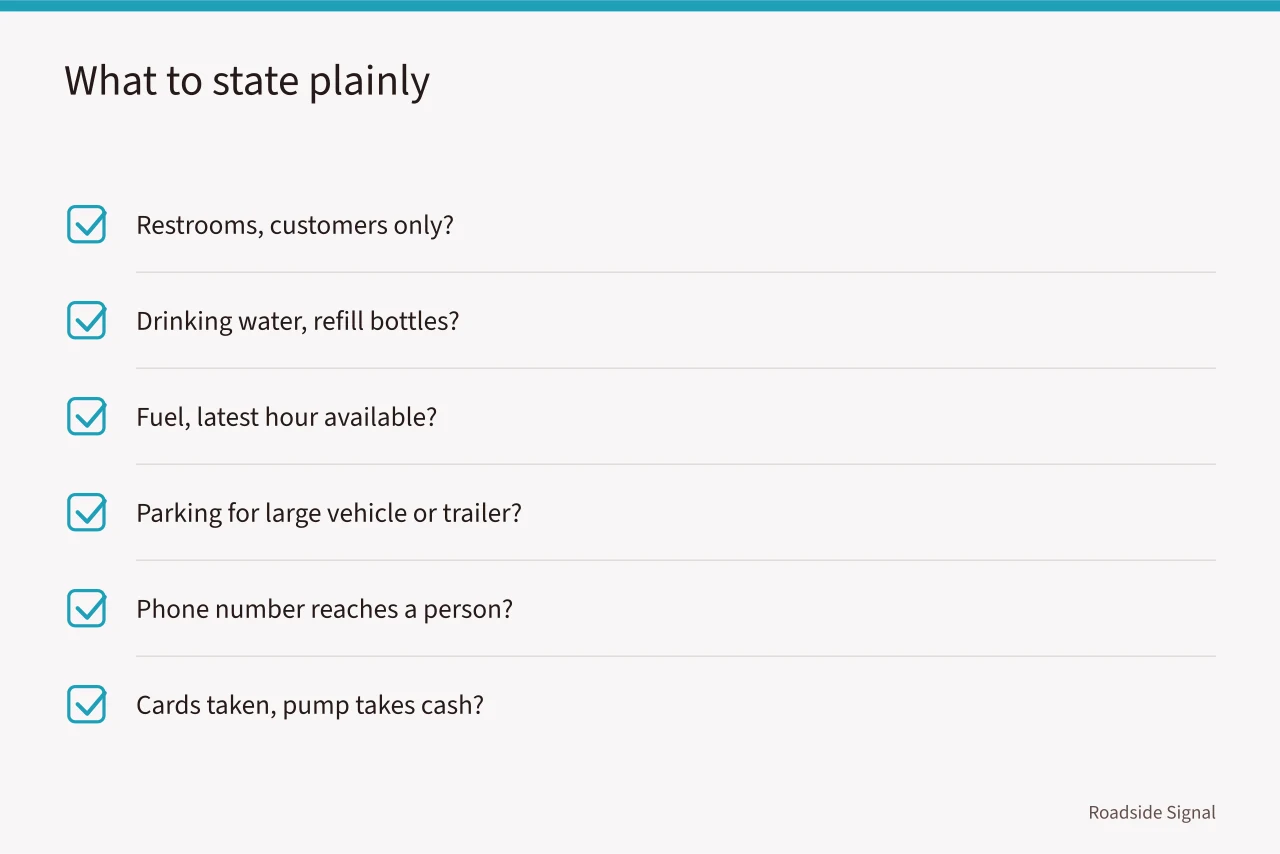
- Say what you havewater, restrooms, fuel late, parking that suits a trailer, and a phone that gets answered.
Travelers on a road trip find businesses through a screen, and the screen is fed by data most owners have never opened. Correcting it is cheap and unglamorous, and it pays better than most advertising.
Accurate pins and real hours fix most of the errors a business can fix itself. Pins, hours, categories and duplicate listings are the fields an owner controls, and they are the ones a traveler notices.
They do not fix everything. Road geometry comes from the map companies, closures come from state transportation agencies, and trailhead pins usually belong to the land manager.
Fix the pin, then the address
Check where your location drops in Google Maps, Apple Maps, Waze and Bing Maps, then drive to the pin. Coordinates often land mid-parcel, behind the building or on the wrong side of a divided highway.
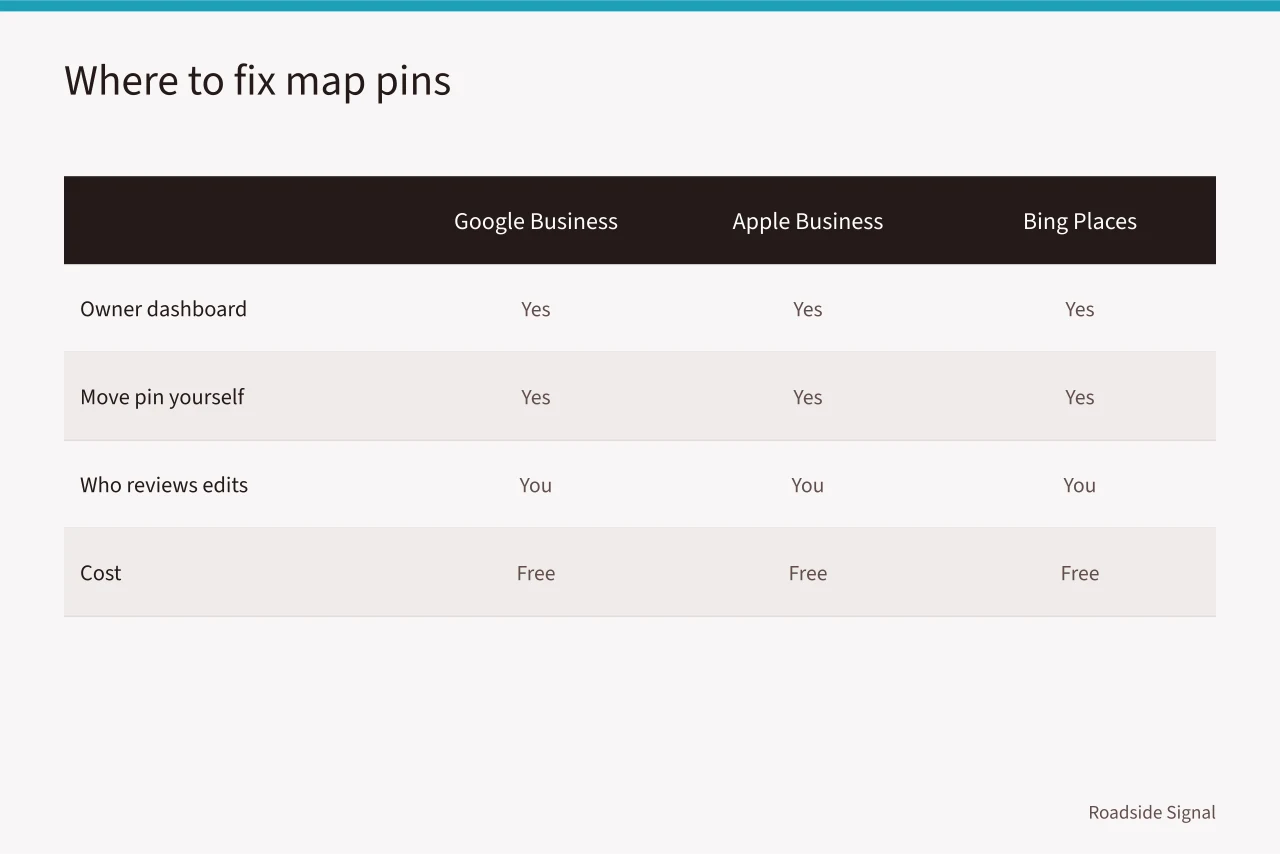
You can move the pin yourself in Google Business Profile, Apple Business Connect and Bing Places. All three are free.
Waze has no owner dashboard. Corrections go through the Waze Map Editor, where volunteer editors review reports.
Claim the listing before you edit it. Unclaimed profiles collect duplicates, and a user suggestion can tag a working business as permanently closed. Pick the primary category with care, because searches like "gas near me" or "campground" filter by category first.
If the entrance is off a side road, put that in the address line. A driver who overshoots at highway speed usually will not come back. Add the direction of approach when it matters: being told to turn before the bridge beats a map tile.
Publish hours that are true, including seasonal ones
Hours decide whether a business gets onto an itinerary. Google Business Profile and Apple Business Connect accept special hours for holidays and seasonal schedules, and neither charges for it.
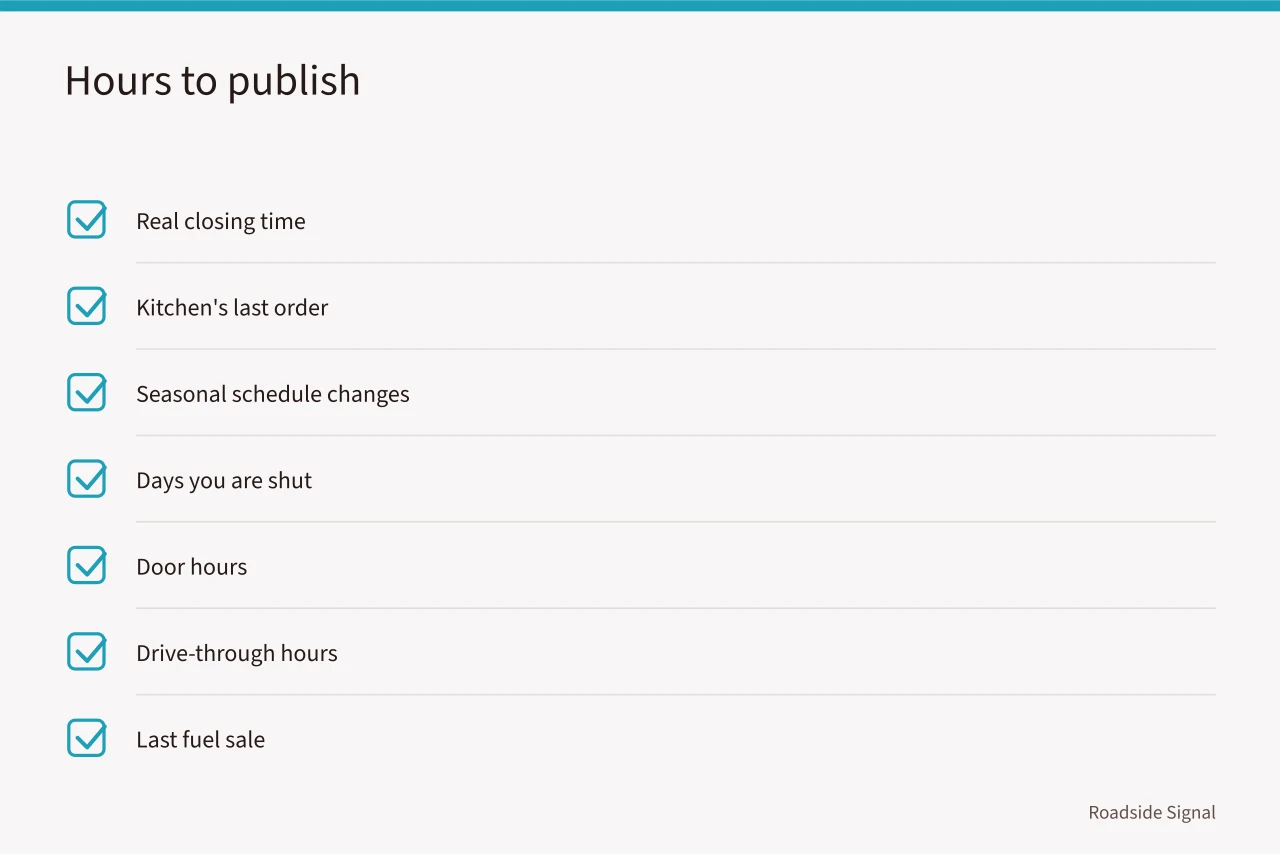
Publish the real closing time, the kitchen's last order, seasonal changes and the days you are shut. Door hours, drive-through hours and the last fuel sale often differ, so list each one. Then keep them current through the season.
A wrong open time is worse than a missing one. It puts you on someone's plan and then fails them.
Get onto official listings
Data you cannot edit yourself often comes from official sources, so list placement matters.
Three national wildlife refuges on Long Island were added to the New York State Birding Trail. The Fish and Wildlife Service noted the state segment highlighted twenty locations across two counties, and said trail information would be available in both English and Spanish. Listings like that propagate into maps, guides and apps for years.
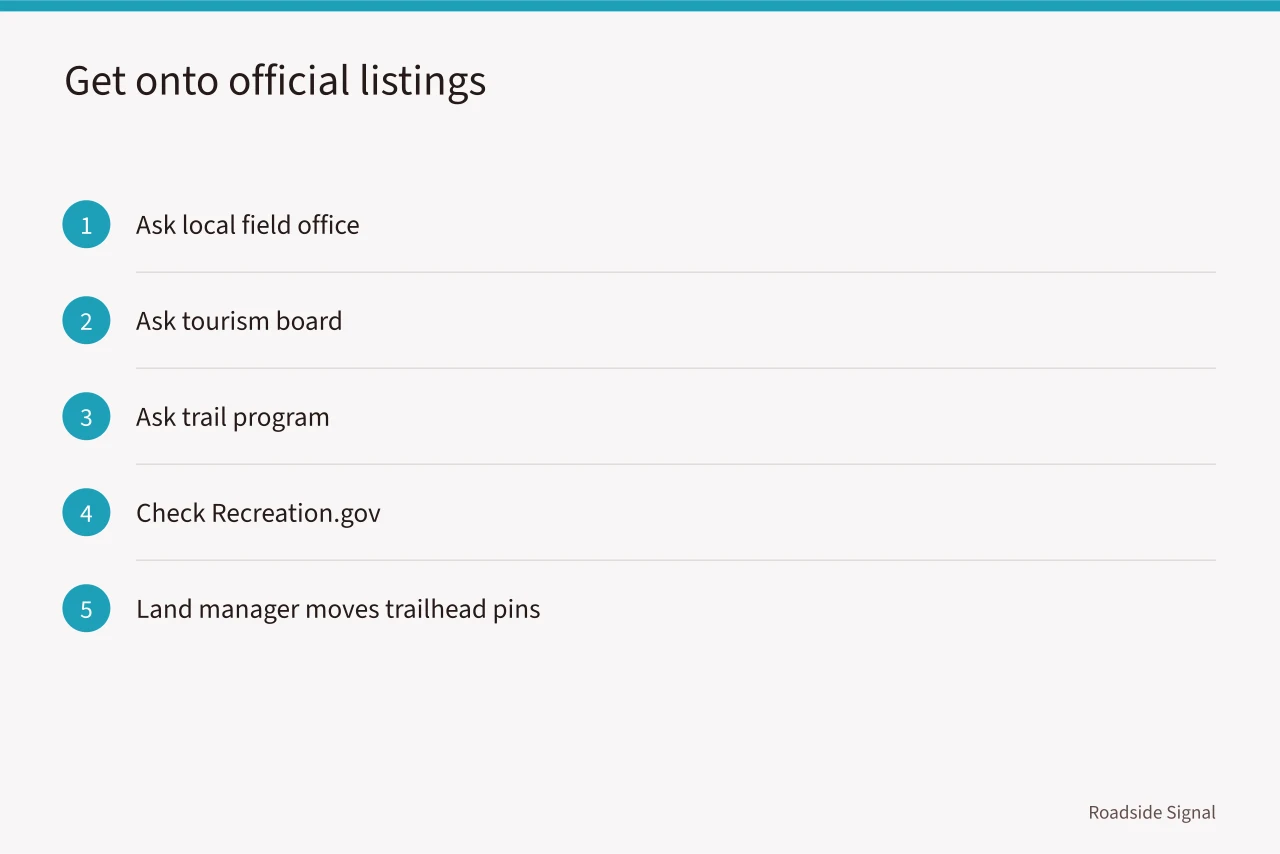
Ask the local field office, tourism board or trail program what listings exist and what it takes to be included. Federal sites also run through Recreation.gov, which appears in search results and in map apps.
Trailheads carry their own pins in AllTrails and Trailforks. When a pin sits at the road instead of the parking area, the land manager is the one who moves it.
Say what you actually have
Public land pages are a good model for the level of detail travelers want. A site page states plainly what is present and what is not, and often points visitors at the nearest town for the rest.
The BLM's page for a mountain bike trail system and campground in western Colorado simply notes that food, lodging and other amenities are available nearby in the City of Fruita. One sentence, and every business in that town benefits from it. A business can be equally plain about its own offer.
Answer the phone at planning time
Most decisions about a stop are made days earlier by someone with a list. A number that rings out drops you off that list quietly. Along a corridor like a designated byway, drivers choose town by town.
State transportation agencies publish closures and seasonal gates, and those records flow into 511 apps and into Waze through its work with state DOTs. You cannot edit that class of error, but you can warn people on your own page.
Being reachable is the difference between a stop and a pass. That is also why it is worth understanding where travelers stay when a route runs out of signal, and what those travelers are checking when they run through the criteria for judging a navigation app.